⚠️ Disclosure: This post contains affiliate links. We may earn a commission at no extra cost to you.
⚠️ Disclosure: This post contains affiliate links. We may earn a commission at no extra cost to you.

edX has grown into one of the world’s largest online learning platforms since its 2012 founding by Harvard and MIT, now offering more than 4,000 courses from 160+ leading global institutions. Whether you’re looking to upskill for a career change, explore a new hobby, or earn a recognized professional credential, edX’s flexible, affordable model makes high-quality education accessible to learners at any stage. To cut through the noise of thousands of available options, we’ve rounded up the 10 most popular, high-impact courses on edX right now, selected based on 2026 enrollment trends, positive learner reviews, and alignment with in-demand job skills.
 edX’s cross-platform design lets you switch between devices seamlessly as you learn
edX stands out from other online learning platforms for its rigorous vetting process: all courses are created and taught by experts from top universities, Fortune 500 companies, and industry-leading organizations, with curricula regularly updated to reflect current trends and best practices. Unlike many competitors, edX lets you audit nearly all courses for free, giving you full access to videos, readings, and discussion forums before you commit to paying for a verified certificate. For learners seeking formal credentials, many courses stack into MicroMasters programs, Professional Certificates, and even full undergraduate and graduate degrees recognized by thousands of employers worldwide. Financial aid is also available for eligible learners, covering up to 90% of certificate costs to remove barriers to access.
These courses span technical, professional, and humanities fields, with options for absolute beginners and experienced learners alike.
This beginner-friendly course is designed for non-technical learners who want to build foundational data literacy skills without needing a background in coding or statistics.
4 weeks, 3–5 hours per week, Beginner level, part of the UCSD Data Science MicroMasters.
Data literacy is now a baseline requirement for most entry-level roles across marketing, operations, and management, as companies increasingly rely on data to drive strategy.
Non-technical career changers, small business owners, and students looking to build foundational data skills for future study or personal use.
 This course uses real-world retail datasets to teach hands-on data analysis skills
Part of the world-famous CS50 series from Harvard and MIT, this course demystifies computer science for absolute beginners, using Python as the core teaching language.
9 weeks, 6–9 hours per week, Beginner level, part of the MITx CS50 series.
Python remains the most in-demand programming language for entry-level tech and non-tech roles, with use cases spanning automation, data analysis, and AI development.
Absolute beginners to programming, professionals looking to automate repetitive work tasks, and learners preparing for more advanced CS coursework.
This intermediate course builds on basic Python skills to teach core AI concepts, with a focus on practical, hands-on project building.
7 weeks, 8–12 hours per week, Intermediate level (requires basic Python knowledge), part of the CS50 AI series.
AI literacy is now a required skill for more than 60% of roles across tech, marketing, and operations, as companies integrate generative AI and automation tools into daily workflows.
Learners with basic Python skills, professionals looking to implement AI solutions in their work, and hobbyists interested in building custom AI tools for personal or professional use.
This course focuses on applying analytics to solve real-world business problems, using case studies from leading global companies to ground theoretical concepts in practice.
10 weeks, 8–10 hours per week, Intermediate level, part of the MITx Analytics MicroMasters.
Business analytics skills are in extremely high demand for mid-level roles, with professionals who can translate data into actionable insights commanding premium salaries across industries.
Mid-career professionals looking to move into analytics, business owners seeking to optimize operations, and learners preparing for professional analytics certifications like the CAP.
This course teaches learners how to lead successful digital modernization initiatives in organizations of any size, with a focus on practical strategy over theoretical concepts.
6 weeks, 4–6 hours per week, Intermediate level, part of the BU Digital Leadership Professional Certificate.
As organizations across every industry invest heavily in digital modernization to stay competitive, demand for leaders who can manage successful transformation initiatives is at an all-time high.
Mid-to-senior level managers, team leads, and entrepreneurs looking to digitize their business operations.
Taught by leading Wharton faculty, this course focuses on building businesses that address the unique challenges and opportunities of developing markets, with a focus on social impact.
8 weeks, 5–7 hours per week, Intermediate level, part of the Wharton Entrepreneurship Specialization.
Emerging markets are projected to drive 60% of global GDP growth by 2030, per World Bank data, creating massive opportunities for entrepreneurs and business leaders who understand these unique contexts.
Aspiring entrepreneurs, social impact leaders, and professionals looking to expand business operations into emerging markets.
Taught by renowned political philosopher Michael Sandel, this iconic course explores moral and political theories of justice and applies them to modern, high-stakes real-world issues.
12 weeks, 3–5 hours per week, Introductory level, no prior philosophy background required.
As global debates over equity, justice, and civic responsibility dominate public discourse, this course helps learners develop the critical thinking skills to engage with these complex, high-stakes issues.
Anyone interested in philosophy, political science, law, or civic engagement, including high school and college students looking for an introduction to moral philosophy.
Taught by leading Civil War historians, this course offers a rigorously researched, balanced overview of one of the most consequential periods in U.S. history, with a focus on primary source analysis.
10 weeks, 4–6 hours per week, Introductory level, includes access to UVA’s exclusive archival materials.
As conversations about U.S. history and civic education continue to evolve, this course offers learners a comprehensive, evidence-based understanding of a pivotal period often misrepresented in public discourse.
History buffs, K-12 educators seeking professional development, and anyone looking to deepen their understanding of U.S. history and its modern implications.
This course blends academic research with practical exercises to explore the intersection of Buddhist contemplative practices, modern psychology, and neuroscience, with no religious requirement for participation.
8 weeks, 3–5 hours per week, Introductory level, no prior background in Buddhism or psychology required.
Mental health and wellness remain top priorities for lifelong learners, with growing interest in evidence-based mindfulness practices that can be integrated into daily life regardless of religious affiliation.
People interested in mental health and wellness, mindfulness practitioners, and students of psychology or religious studies.
Taught by renowned Shakespeare scholar Stephen Greenblatt, this course makes Shakespeare’s work accessible to all learners, regardless of prior experience with his writing.
12 weeks, 3–4 hours per week, Introductory level, includes clips from modern Shakespeare adaptations to connect classic text to contemporary culture.
As classical education sees a resurgence among lifelong learners, this engaging, accessible course offers a deep dive into Shakespeare’s work from one of the world’s leading literary scholars.
Literature lovers, students, educators, and anyone who has struggled to connect with Shakespeare’s work and wants to build a stronger understanding of his writing.
If none of the courses above align with your learning goals, edX offers thousands of additional options across dozens of fields, including:
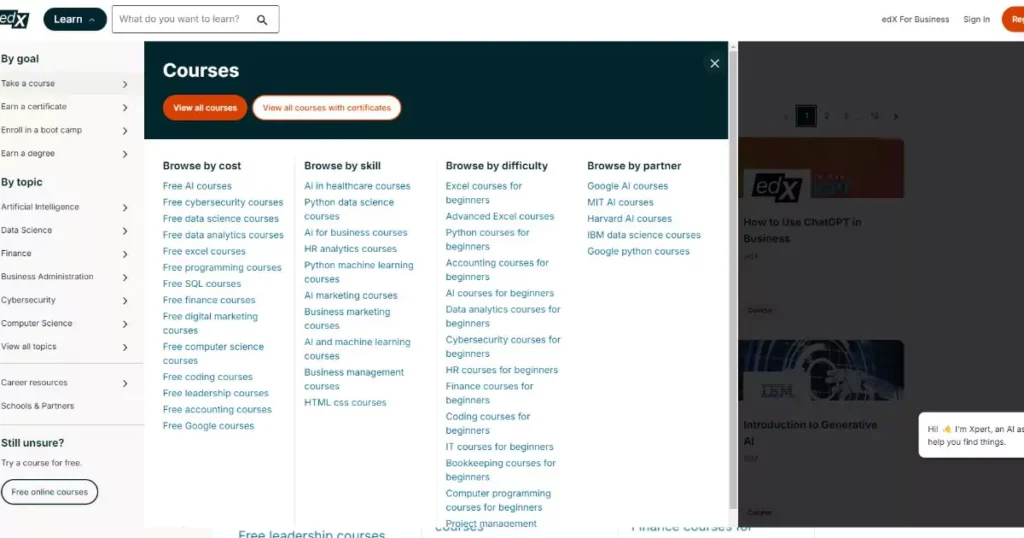
 edX’s searchable catalog lets you filter courses by topic, level, and institution
Image source: edX All Courses List
edX’s searchable catalog lets you filter courses by topic, level, and institution
Image source: edX All Courses List
With thousands of courses to choose from, narrowing down your options can feel overwhelming. Start by clarifying your core goal: are you looking to upskill for a specific career move, explore a new hobby, earn a professional credential, or simply learn for fun? Next, check the course format: self-paced courses let you learn on your own schedule, while cohort-based courses offer fixed start dates and peer interaction for more structure. Finally, read recent learner reviews to get a sense of the course’s difficulty, instructor engagement, and real-world applicability. A common mistake new edX learners make is enrolling in too many courses at once, leading to burnout — start with one course that aligns directly with your top priority, and build from there.
To get the most out of your edX course, set a consistent weekly study schedule, even if it’s just 30 minutes a day. Take advantage of discussion forums to connect with other learners and ask questions of instructors. Most courses can be audited for free, giving you access to all course materials before you commit to paying for a verified certificate. If you do choose to purchase a certificate, edX offers financial aid for eligible learners, covering up to 90% of the cost. Once you complete a course, you can add your verified certificate to your LinkedIn profile and resume, and learn how to highlight these credentials effectively in our guide to adding edX credentials to your professional profiles.
edX’s model is built to remove common barriers to high-quality education:
Enrolling takes just a few minutes:
edX adds hundreds of new courses each year, with 2026’s most popular new offerings covering topics like generative AI engineering, sustainable business strategy, and mental health counseling. You can browse all new and trending courses on the edX website’s "New & Trending" tab.
Nearly all edX courses can be audited for free, which gives you unlimited access to all course videos, readings, and discussion forums for the duration of the course. You only pay if you want a verified certificate to share with employers or academic institutions. Financial aid is available for eligible learners, covering up to 90% of the certificate cost.
To enroll, create a free edX account, search for your desired course, select your preferred track (audit or verified), and click "Enroll Now." You’ll get immediate access to course materials if the session is currently active, or you can join the waitlist for upcoming sessions.
Yes, most edX courses offer a verified certificate for a fee, which includes graded assignments, exams, and a shareable digital credential that can be added to your LinkedIn profile, resume, or academic portfolio. Many courses also stack into Professional Certificates, MicroMasters programs, or even full undergraduate and graduate degrees, which include their own accredited credentials.
edX’s vast library of high-quality, affordable courses makes it one of the best resources for learners at any stage of their career or education journey. The 10 courses highlighted above cover some of the most in-demand skills for 2026, from technical data science and AI to humanities and professional development, with options for absolute beginners and experienced learners alike. Whether you’re looking to switch careers, advance in your current role, or simply explore a new passion, edX has a course that fits your goals and schedule. Ready to start building new skills? Browse the full edX course catalog today to find the perfect option for you, and take the first step toward achieving your personal and professional goals.

Ms.Sultana brings over 16 years of expertise working with global Clients by providing different skills and Services. For the last 5 years working as an Affiliate marketer, specializing in high-ticket campaigns that drive exponential growth. She holds a degree in Computer Science and Engineering as well as achieved many more skills certificates from different institute/academies/Platform. As part of the Elite Global Marketing team, Sultana has helped clients generate millions in revenue through strategic partnerships, innovative funnels, and data-driven insights.

















Still wondering how to train a virtual assistant? You’re not alone. Millions of people and businesses want help from AI but don’t know where to start. The good…

Struggling to get a new virtual assistant up to speed without wasting hours? Knowing how to onboard a virtual assistant properly can transform your business…

 Image source: Bing (Web (fairuse with source credit)) How to find a virtual…