⚠️ Disclosure: This post contains affiliate links. We may earn a commission at no extra cost to you.
⚠️ Disclosure: This post contains affiliate links. We may earn a commission at no extra cost to you.


Coursera is one of the world’s largest online learning platforms, partnering with 300+ top universities (Stanford, Yale, University of Illinois) and industry leaders (Google, IBM, Meta) to serve over 130 million learners globally as of 2026. For job seekers, career changers, and upskilling professionals, the question of whether Coursera certifications deliver tangible career value is a top priority. The short answer? It depends entirely on three core factors: employer recognition of the specific certification, the rigor of its skill validation, and how it aligns with your personal career goals. This guide breaks down exactly what you need to know to decide if a Coursera certification is a smart investment for you.
The first and most critical factor in a Coursera certification’s value is whether employers in your target industry actually recognize and prioritize it. For most non-regulated roles, employer perception of online credentials has improved dramatically in recent years, driven by a widespread shift toward skills-based hiring. According to the Society for Human Resource Management (SHRM) skills-based hiring guidance, 72% of employers now consider industry-recognized online credentials as part of entry-level and mid-career hiring evaluations, a 20% increase from 2020 as traditional degree costs continue to rise.
A Coursera certification’s value is almost entirely tied to its issuing partner:
A common mistake job seekers make is listing generic Coursera certifications on their resume without tying them directly to the skills listed in the job description, which leads to them being ignored by applicant tracking systems (ATS).
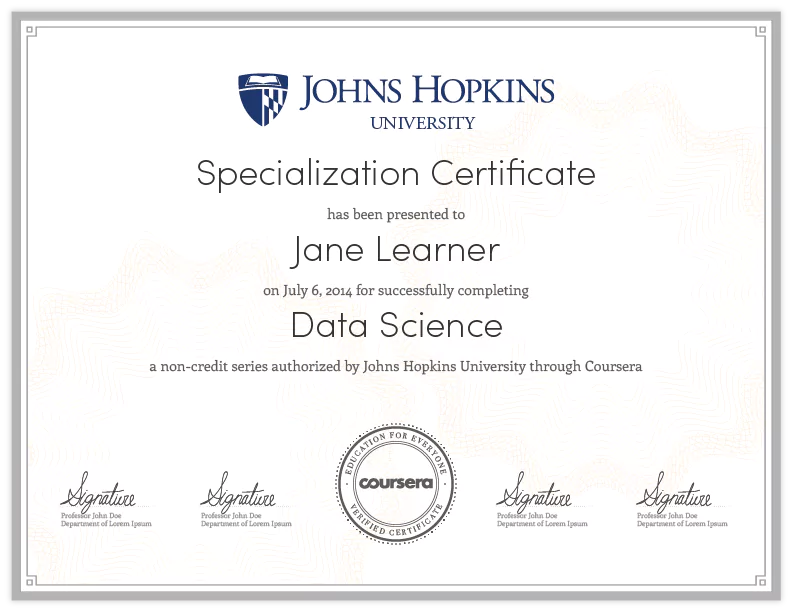 This sample certificate is issued for completion of a Coursera course developed in partnership with an accredited higher education institution.
The second key factor is whether the certification actually proves you have mastered job-relevant skills, rather than just confirming you watched a series of videos. Not all Coursera certifications are created equal when it comes to assessment rigor.
The table below outlines the key differences between common Coursera certification types, so you can identify which offer credible skill validation:
| Certification Type | Grading & Assessment Rigor | Typical Time to Complete | Best For |
|---|---|---|---|
| Professional Certificate (Google, IBM, Meta) | Proctored exams, peer/instructor-reviewed hands-on projects, graded quizzes | 3-6 months (part-time) | Career changers, upskilling for in-demand roles |
| University Specialization | Instructor-graded assignments, peer reviews, final capstone project | 1-6 months | Supplementing formal education, niche skill building |
| Individual Course Certificate | Ungraded or auto-graded quizzes, no proctoring | 2-8 weeks | Personal interest, introductory skill exploration |
| Degree Programs (Bachelors, Masters) | Full accredited university curriculum, proctored exams, instructor grading | 1-4 years | Full degree substitution for eligible roles |
For example, the Google Data Analytics Professional Certificate requires learners to complete 8 hands-on projects using real-world datasets, with final projects reviewed by Google employees, making it a credible validation of practical skills. In contrast, many low-cost individual course certificates only require passing ungraded multiple-choice quizzes, which do little to prove competency to employers.
Most individual Coursera course and Professional Certificates are not formally accredited by the U.S. Department of Education, meaning they do not count toward a college degree on their own. However, all Coursera Degree Programs are accredited by the regional accrediting bodies of their partner universities, making them equivalent to traditional on-campus degrees for most employers. Professional Certificates from partners like Google and IBM are not accredited, but they carry industry-specific credibility that often outweighs formal accreditation for technical roles.

The third critical factor is whether the cost of the certification delivers a return on investment aligned with your goals. Coursera certifications are far more affordable than traditional education, but their value depends on how you use them.
As of 2026, Coursera’s pricing structure is as follows:
The table below outlines typical ROI for common use cases, based on public data from Coursera and partner employers:
| Use Case | Total Investment | Typical Career Benefit |
|---|---|---|
| Google IT Support Professional Certificate for entry-level tech role | ~$400 | $5,000-$10,000 annual salary increase, or job offer for candidates with no prior experience |
| University Specialization for promotion in current role | ~$200 | $3,000-$8,000 annual salary increase, or eligibility for senior roles |
| Casual personal interest course | ~$50 | No direct financial ROI, but personal skill growth |
| Full online bachelor's degree | ~$20,000 | $15,000-$30,000 annual salary increase vs. high school diploma |
For most career-focused learners, a Professional Certificate or Specialization delivers an ROI of 10x or more in the first year if you use the skills to qualify for a new role or promotion. For personal interest learners, the low cost makes it a low-risk investment even with no direct financial return. Note that Coursera offers need-based financial aid for 90% of paid courses, so cost is rarely a barrier for motivated learners.
 Coursera's mobile app lets learners complete coursework on any device, with offline access for busy schedules.
Credit: learnopoly.com
Coursera's mobile app lets learners complete coursework on any device, with offline access for busy schedules.
Credit: learnopoly.com
Coursera certifications are not a one-size-fits-all solution, and they are not the right choice for every learner.
Pro tip: If you’re unsure if a specific Coursera certification is right for you, start with a free audit of the course to review the content, instructor, and assignments before paying for the certificate.
While Coursera is a strong option for many learners, it’s not the only platform offering online certifications. Here’s how it compares to top alternatives:
| Platform | Best For | Certification Value | Pricing Model |
|---|---|---|---|
| edX | University-backed degrees and academic courses | High (partnered with Harvard, MIT, etc.) | Free to audit, $50-$300 per certificate, $15k-$30k for degrees |
| Udacity | Tech-focused Nanodegrees with project-based learning | Moderate to high (partnered with industry leaders) | $300-$600 per month, 2-6 month programs |
| LinkedIn Learning | Short, practical courses for business and creative skills | Low to moderate (recognized by some employers for skill gaps) | $29.99/month subscription, unlimited access |
| Udemy | Practical, low-cost courses for specific skills | Low (no formal partner recognition) | $10-$100 per course, lifetime access |
If you’re looking for a low-cost way to learn a specific practical skill (e.g., Photoshop, Excel), Udemy may be a better fit. If you want an accredited degree, edX is a strong alternative to Coursera’s degree programs.
Most individual course and Professional Certificates on Coursera are not formally accredited by the U.S. Department of Education, meaning they do not count toward a college degree on their own. However, all Coursera Degree Programs (bachelor's, master's) are accredited by the regional accrediting bodies of their partner universities, making them equivalent to traditional on-campus degrees for most employers.
No, Coursera certifications do not expire. Once you earn a certificate, it remains on your Coursera profile and can be added to your resume or LinkedIn profile permanently. However, some employers may prefer certificates earned within the last 3-5 years for roles that require up-to-date skills, as technology and industry best practices change quickly.
It depends on the role and the certification. For entry-level tech roles like IT support, data analysis, and digital marketing, many employers hire candidates with only a relevant Coursera Professional Certificate, especially if they can demonstrate the skills in interviews and projects. For regulated or advanced roles, you will still need a traditional degree or license alongside any online certifications.
Yes, for high school students looking to explore college majors, build college applications, or learn practical skills before entering the workforce. Coursera for Campus offers free access to high school students at many schools, and the certifications can demonstrate initiative and skill to college admissions officers.
The value of a Coursera certification comes down to three clear, actionable factors:
For most career-focused learners in non-regulated fields, a high-quality Coursera Professional Certificate or University Specialization is a low-cost, high-ROI investment that can lead to new job opportunities, promotions, and salary increases. For personal interest learners, the low cost and flexible format make it a risk-free way to build new skills.
Ready to explore? Start with a free audit of a top-rated Coursera Professional Certificate to test the content quality and see if it aligns with your learning style before you commit to paying for the full program.
The value of Coursera certifications is backed by aggregated, publicly reported outcome data from Coursera and its partners, providing concrete evidence of their real-world impact:
These outcomes highlight a consistent trend: the career value of a Coursera certification is directly tied to its alignment with in-demand, employer-validated skills and the credibility of its issuing partner. Generic, low-stakes certifications with minimal assessments deliver far weaker outcomes, so learners should prioritize programs with rigorous, hands-on requirements.
As of 2026, the value of Coursera certifications is projected to grow, driven by three key industry shifts:
For learners, this means that high-quality, partner-backed Coursera certifications will only become more recognized and valuable in the coming years, as skills-based hiring becomes the global standard for talent evaluation.
To recap the three core factors that determine whether a Coursera certification is valuable for you:
When used strategically, Coursera certifications are a low-risk, high-reward tool for upskilling, career advancement, and lifelong learning. They are not a replacement for formal accredited degrees in regulated fields, but for non-regulated roles, they offer exceptional value for the cost and time invested.

Ms.Sultana brings over 16 years of expertise working with global Clients by providing different skills and Services. For the last 5 years working as an Affiliate marketer, specializing in high-ticket campaigns that drive exponential growth. She holds a degree in Computer Science and Engineering as well as achieved many more skills certificates from different institute/academies/Platform. As part of the Elite Global Marketing team, Sultana has helped clients generate millions in revenue through strategic partnerships, innovative funnels, and data-driven insights.















 Image source: Bing (Web (fairuse with source…

You’re weighing a virtual assistant for appointment scheduling because the email backandforth is eating your day. Pick wrong and you’ll either scare off…
You’re wasting hours every week on email tag just to lock a meeting time. A virtual assistant for meeting scheduling can cut that admin load, but the options…