⚠️ Disclosure: This post contains affiliate links. We may earn a commission at no extra cost to you.
⚠️ Disclosure: This post contains affiliate links. We may earn a commission at no extra cost to you.


Breaking into data science can feel like staring at an impossibly steep mountain. The field moves fast, job descriptions read like wish lists, and it’s easy to waste months going in circles. The good news: a structured, project-driven approach to learning data science online works, and it works well — provided you avoid a few common traps. This guide maps out the entire journey, from selecting your first course to walking into an interview with a portfolio that actually tells a story.
Before you download a single dataset, it’s worth untangling what the term actually covers. A lot of learners quit early because they expect only machine learning magic, then get buried in SQL queries, data cleaning, and endless bar charts.
Data science sits at the crossroads of three areas:
In practice, a data scientist spends a surprising amount of time on data wrangling — reshaping messy spreadsheets, handling missing values, and merging sources — before any modeling begins. If you enjoy detective work and a bit of frustration, you’ll do fine.
Organisations across healthcare, finance, logistics, and even agriculture rely on data to cut costs and uncover opportunities. That demand hasn’t slowed. The U.S. Bureau of Labor Statistics projects strong growth for data-related roles, and while job titles shift, the core ability to extract insights from data remains a durable skill. Learning this discipline online puts you in control of exactly how and when you build that skill.
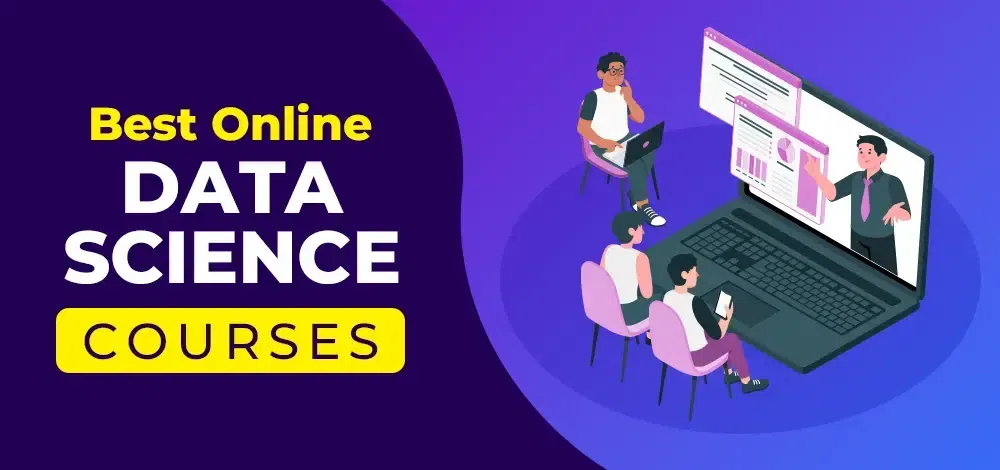 A typical online data science setup with a code editor, terminal, and visualization dashboard.
The biggest mistake newcomers make is signing up for a long course and trying to “finish” it in one exhausting sprint. That approach burns you out before you reach the material that actually matters for employment.
Swap “learn machine learning” for specific, measurable targets:
These micro-goals keep your momentum up and give you concrete items for a portfolio from the very first month. Tracking them in a simple log — even a Notion page — makes progress tangible. When motivation dips, that log is the proof you need that you’re moving forward.
Treat study sessions like unmissable meetings. Even 45 focused minutes a day, five days a week, easily outperforms six-hour weekend binges. Consistent repetition encodes the syntax and concepts into long-term memory far better than cramming. If you’re balancing a full-time job, early mornings or lunch breaks tend to be the hours that actually stay protected.
An effective way to structure that time: use the first 10 minutes to review what you did yesterday, 25 minutes for new material, and 10 minutes to apply it — write a quick script or solve one small problem. It mirrors how you’ll work on the job.
The sheer number of options can freeze you in place. A few clear filters eliminate 90% of the noise.
Choosing a platform often comes down to whether you need external accountability (go with Udacity or a live bootcamp) or you thrive building things independently (pair DataCamp with Kaggle competitions). There is no single “best” course — there’s only the one you’ll finish.
Before swiping your card, scan the syllabus for these non-negotiables:
If a syllabus skips data cleaning straight to machine learning, walk away. In practice, real-world data arrives dirty, and that’s where you’ll spend most of your time — and where you can really showcase your practical problem-solving skills in interviews.
 A core stack of data science tools every learner should become comfortable with.
You don’t need to master every shiny new library. A deep command of a focused stack gets you further than shallow familiarity with twenty tools.
Pick either Python or R and commit for at least three months before dabbling in the other. Python’s ecosystem (pandas, NumPy, scikit-learn, matplotlib, seaborn) is the de facto industry standard outside of heavily academic or statistical research roles. R holds an edge for specialised statistical analysis and elegant visualization with ggplot2, and it’s worth learning later if your domain work calls for it.
A common beginner trap: learning syntax from a book but never opening a real dataset. The day you feel stuck writing a loop to clean a column of messy dates is the day you’re actually learning.
Data lives in databases, and SQL is the key to getting it out. Interview loops at nearly every company that hires data scientists include a live SQL test. Spend focused weeks on:
Practice on real database environments like PostgreSQL or SQLite. Many learners mistakenly assume SQL is trivial and skip it; it often becomes the single reason they fail a technical screen.
Jupyter Notebooks excel for exploration and sharing visual output. But as projects grow, you’ll need an IDE — VS Code with the Python extension is a solid, free choice. Use notebooks to prototype, then move reusable logic into .py scripts stored in a clean GitHub repository. Employers reviewing your code will notice that discipline.
Watching videos feels productive, but it’s a passive comfort zone. The turning point for every authentic data science learner is the first messy, unscripted project.
Public repositories provide free, real-world datasets that aren’t sanitised for teaching:
Download a dataset in a domain you care about — sports analytics, public health, climate — and your intrinsic interest will carry you through the tough debugging sessions.
Move beyond Titanic and iris flowers as soon as you can. Strong beginner-to-intermediate projects include:
For each project, document your process in a README: what problem you solved, why you chose the approach you did, and one thing you’d improve with more time. That narrative is what hiring managers read.
 The visual output of a completed data science project, from raw data to interpretable dashboard.
Learning alone eventually hits a ceiling. Engaging with fellow learners and practitioners shortens that plateau dramatically.
Lurk first, then start answering questions. Explaining a concept to someone else is one of the fastest ways to solidify your own knowledge — a practical observation that consistently surprises new members.
Not everyone can afford a formal mentor. Free or low-cost alternatives work: contribute to open-source data science projects on GitHub, attend virtual meetups posted on LinkedIn Events, and don’t underestimate the value of a thoughtful comment on a senior practitioner’s blog. People notice genuine curiosity and effort. Over time, those connections often become mentors organically.
Techniques that dominated job descriptions a few years ago can become less central as tools evolve. Keeping up doesn’t mean chasing every headline, though.
A practical habit: maintain a personal “tech watch” markdown file where you briefly summarise what you learned each week. The act of writing cements it better than passive reading, and it becomes a searchable reference over time.
Your portfolio and network only work if you can navigate the interview process itself, which follows a predictable pattern.
| Role | Core Focus | Key Tools |
|---|---|---|
| Data Analyst | Interpreting data, building dashboards, reporting | SQL, Excel, Tableau/Power BI |
| Data Scientist | Statistical modeling, experimentation, advanced analytics | Python/R, SQL, scikit-learn |
| Data Engineer | Building and maintaining data pipelines, infrastructure | SQL, Python, Airflow, Spark |
| Machine Learning Engineer | Designing, deploying, and monitoring ML models | Python, TensorFlow/PyTorch, Docker |
| BI Analyst | Business-oriented analysis and KPI monitoring | SQL, Power BI, Looker |
Clarity about which role plays to your strengths lets you tailor both your learning and your resume, rather than trying to be everything at once.
A typical technical interview includes:
Practise aloud. Explain why you chose one model over another, what you’d do if the data were 10× larger, and how you’d validate results. If you can describe the trade-offs clearly, you’ll stand out from candidates who only memorised syntax.
Building a strong foundation for a career like this often starts with understanding how targeted capability-building courses can accelerate growth. Many successful transitions into data science come from people who first spent time developing a broader skill-acquisition mindset, then layered in technical depth. In fact, the current landscape of in-demand online earning skills consistently ranks data fluency near the top, which makes the time you invest here particularly timely. While you map out which certifications matter, it helps to have a curated shortlist of programmes that offer recognised credentials. And if you ever wonder whether you’re approaching the learning process itself efficiently, revisiting what systematic skills improvement looks like can refocus your plan within an hour.
 The reality of learning data science online: a quiet desk, a capable laptop, and a lot of hands-on practice.
Is it still possible to learn data science online without a technical degree?
Yes. Many working data scientists come from non-CS backgrounds such as biology, economics, or journalism. A structured learning path, consistent practice, and a portfolio of applied projects can substitute for a formal degree. Employers care far more about demonstrable skill than about your university major.
How long does it take to become job-ready?
A realistic timeframe for a dedicated learner starting from scratch is 8–12 months, assuming 10–15 focused hours per week. That estimate includes building 3–4 substantial projects you can discuss in-depth. Shortcuts that promise readiness in six weeks usually skip the messy, invaluable parts — SQL, data cleaning, and probability.
Which programming language should I learn first?
Start with Python. Its syntax is beginner-friendly, and it dominates production data science. Libraries like pandas, scikit-learn, and matplotlib form a cohesive toolkit. Once you’re comfortable, picking up R or Julia is a reactive process driven by your specific domain.
Are certificates necessary?
Certificates alone rarely land you a job, but they can provide structure and a signal of commitment. The real value comes from the project work you complete alongside the certificate. When listing a credential on your resume, always pair it with a concrete outcome — “Completed X specialisation and built a customer lifetime value model using retail transaction data.”
What’s the most underrated skill in data science?
Data storytelling. An analyst who can translate a complex model into a one-page executive summary generates more organisational impact than one who only focuses on technical metrics. Practice writing project reports that explain the “so what?” — the business action your insight enables.
Where can I find free datasets safe for commercial portfolio use?
The UCI Machine Learning Repository is a reliable university-hosted collection. Government portals like Data.gov also provide openly licenced data across numerous sectors. Always check the licence, but the vast majority are suitable for learning and portfolio display.
Learning data science online is not about collecting certificates or bingeing video lectures. It’s about consistently solving small, real problems, learning from the errors that inevitably surface, and building a body of work that proves you can deliver insight from raw data. The roadmap laid out here — clear micro-goals, a focused technical stack, hands-on projects drawn from authentic datasets, and a deliberate approach to community and interview prep — removes the guesswork. The field will keep evolving, but the habits you build now will equip you to evolve alongside it. Start today, share your first project in a public space this week, and let that momentum carry you forward.

Ms.Sultana brings over 16 years of expertise working with global Clients by providing different skills and Services. For the last 5 years working as an Affiliate marketer, specializing in high-ticket campaigns that drive exponential growth. She holds a degree in Computer Science and Engineering as well as achieved many more skills certificates from different institute/academies/Platform. As part of the Elite Global Marketing team, Sultana has helped clients generate millions in revenue through strategic partnerships, innovative funnels, and data-driven insights.














how to create SOPs for virtual assistants is harder than it sounds. You’ve got one VA handling email, another doing bookkeeping, and a third managing social…
The problem most founders face isn’t hiring the wrong person, it’s giving them work that lives nowhere concrete. If you’ve ever wondered how to manage virtual…

How to communicate with a virtual assistant effectively comes down to one simple truth: these systems aren’t mind readers. They’re patternmatching machines…