⚠️ Disclosure: This post contains affiliate links. We may earn a commission at no extra cost to you.
⚠️ Disclosure: This post contains affiliate links. We may earn a commission at no extra cost to you.

In 2026, the barrier to high-quality, career-relevant education is lower than ever, and Coursera’s free course library is one of the most accessible resources for learners worldwide. With rising costs of traditional higher education and rapidly shifting job market demands — especially in AI, data analytics, and digital marketing — free upskilling is no longer a nice-to-have, but a practical tool for career growth, personal enrichment, and testing new fields without financial risk. This guide breaks down exactly how to access Coursera’s free offerings, which courses deliver the most tangible value in 2026, and how to turn free learning into real-world outcomes, whether you’re a student, working professional, career switcher, or lifelong learner.
Coursera is a leading online learning platform founded in 2012 by Stanford University computer science professors, with partnerships spanning 300+ top-tier institutions including Yale, University of Michigan, Google, IBM, and the World Bank. The platform hosts more than 10,000 individual courses, 40+ professional certificates, 20+ fully online degrees, and 7,000+ guided projects, covering subjects from machine learning and public health to creative writing and personal finance.
It’s important to clarify a common misconception early: Coursera’s “free courses” refer to audit access, which gives you full access to all course lecture videos, readings, and ungraded practice quizzes at no cost. The only features locked behind payment are graded assignments, proctored exams, and shareable digital certificates. Many users also confuse free audit access with “financial aid” — a separate program that covers 100% of certificate costs for learners who demonstrate financial need, with no obligation to repay.
Unlike free learning resources scattered across YouTube or random blogs, Coursera’s free courses are designed by faculty at accredited universities and industry leaders at top companies, so you can trust the content is accurate, up-to-date, and aligned with real-world job requirements. As noted by the U.S. Department of Education, free online learning resources have expanded access to high-quality education for 60% more U.S. learners over the past five years, bridging gaps for low-income, rural, and working adult populations.
Key benefits of free Coursera courses include:
A common mistake new learners make is assuming free courses are “lower quality” than paid ones — in practice, the core course content (lectures, readings, practice materials) is identical for audit and paid learners, so you’re not missing out on core educational value by choosing the free option.
Enrolling in a free Coursera course takes less than 5 minutes, but a few small details can help you avoid accidentally signing up for a paid plan. Follow these steps to access full course content for free:
Below is a quick reference table for the enrollment process:
| Step | Action | Pro Tip |
|---|---|---|
| 1 | Create a Coursera account | Use a dedicated email for learning to avoid course notifications cluttering your primary inbox |
| 2 | Search for your target course | Filter by “Free” to narrow results to courses with no-cost audit access |
| 3 | Select “Audit for Free” enrollment | Avoid clicking the default “Enroll for Certificate” button, which will prompt you to enter payment details |
| 4 | Access course materials | Download lecture slides and readings for offline use via the Coursera mobile app |
Note: If you’re a student, employee of a partner company, or resident of a country with a Coursera for Campus or Government partnership, you may have access to free certificates and additional courses at no cost — check your eligibility in your account settings.
For a visual walkthrough of the enrollment process, watch the short tutorial below: Step-by-step video guide to enrolling in free Coursera courses Step-by-step video walkthrough of creating a Coursera account and enrolling in your first free course
With thousands of free courses available, it can be overwhelming to choose which ones will deliver the most tangible value for your goals. Below are the highest-rated free Coursera courses as of 2026, organized by category, with details on key skills you’ll learn and ideal use cases for each.
| Course Name | Institution | Duration | Key Skills Learned | Ideal For |
|---|---|---|---|---|
| Machine Learning | Stanford University | 11 weeks | Supervised/unsupervised learning, neural networks, Python for ML, model evaluation | Aspiring data scientists, software engineers looking to add ML skills |
| Programming for Everybody (Python) | University of Michigan | 7 weeks | Python syntax, loops, conditional statements, basic data manipulation | Absolute beginners to coding, non-technical professionals looking to automate tasks |
| AI for Everyone | DeepLearning.AI | 4 weeks | AI fundamentals, use cases for generative AI, ethical AI implementation, evaluating AI tools | All professionals, business leaders, and learners looking to understand AI's real-world applications |
| Google Data Analytics Professional Certificate (First 2 Courses Free) | 6 months (full program) | Data cleaning, visualization with Tableau, SQL, data analysis with R | Career switchers looking to break into entry-level data analyst roles |
| Course Name | Institution | Duration | Key Skills Learned | Ideal For |
|---|---|---|---|---|
| Successful Negotiation: Essential Strategies and Skills | University of Michigan | 5 weeks | Negotiation tactics, conflict resolution, value creation, deal structuring | Professionals, managers, and entrepreneurs looking to improve negotiation outcomes |
| Digital Marketing Fundamentals | University of Illinois | 4 weeks | SEO, content marketing, social media strategy, paid advertising basics | Small business owners, marketing beginners, professionals looking to upskill in digital channels |
| Financial Management for Non-Financial Professionals | University of California, Irvine | 3 weeks | Budgeting, financial statement analysis, cash flow management | Startup founders, team leads, and non-finance professionals looking to make data-driven business decisions |
| Course Name | Institution | Duration | Key Skills Learned | Ideal For |
|---|---|---|---|---|
| The Science of Well-Being | Yale University | 10 weeks | Positive psychology, habit formation, stress reduction, productivity hacks | All learners looking to improve mental health and work-life balance |
| Learning How to Learn | McMaster University | 4 weeks | Memory retention techniques, overcoming procrastination, effective study habits | Students, lifelong learners, and professionals looking to learn new skills faster |
| Career Success | University of California, Irvine | 6 weeks | Resume writing, interview skills, personal branding, networking strategies | Job seekers, recent graduates, and professionals looking to advance their careers |
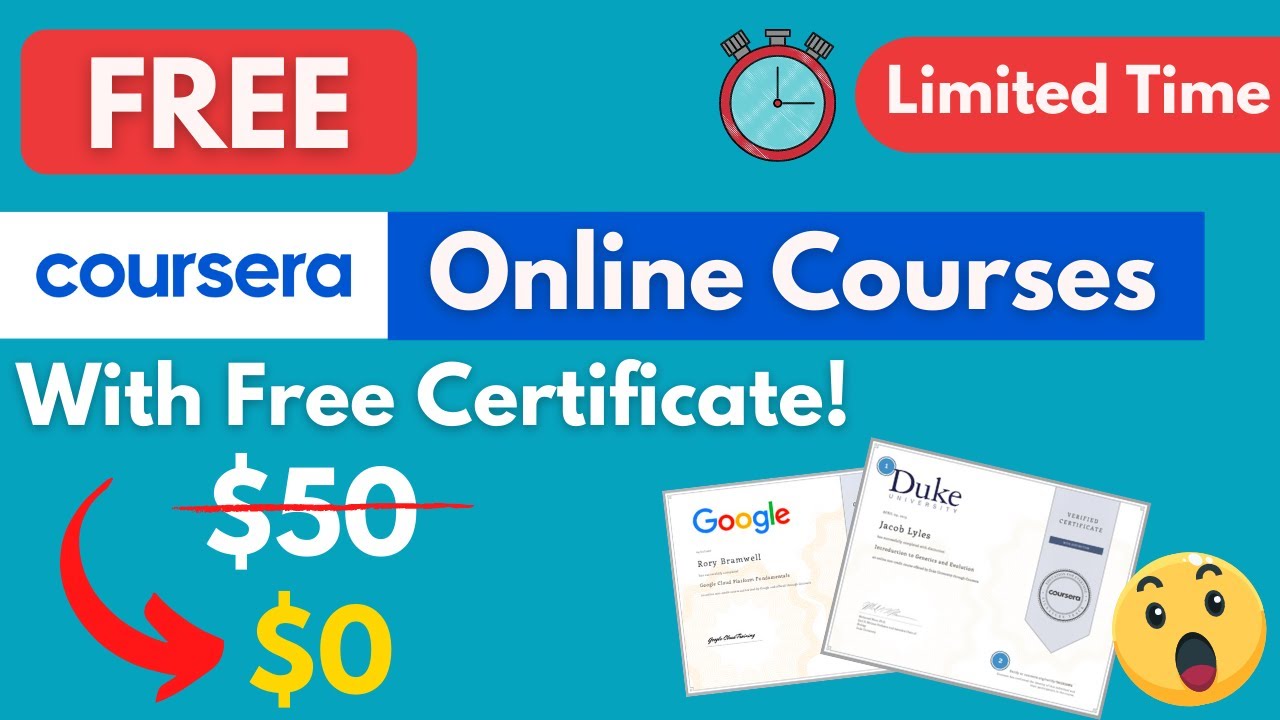 Coursera's free course library spans thousands of topics across technology, business, health, and the arts
One of the most common questions learners have about Coursera’s free courses is whether they include a shareable certificate, and how much value those certificates hold in the job market. Here’s a clear breakdown of what to expect:
As noted earlier, free audit access gives you full access to all core course content, but does not include a shareable certificate or access to graded assignments. To earn a certificate, you have two options:
Coursera certificates hold credible value in the job market, particularly for entry-level and mid-career roles. Coursera’s 2025 Learner Outcomes Report found that 78% of hiring managers recognize and value Coursera professional certificates, and 42% of learners who completed a free or paid Coursera course reported a promotion, raise, or new job within 6 months of completion.
That said, certificates are most valuable when paired with tangible proof of skill: for technical roles, pair your certificate with a portfolio of projects you built during the course (e.g., a machine learning model you developed for the Stanford Machine Learning course); for business roles, include a sample strategy document or analysis you completed as part of the coursework.
If you’re weighing Coursera against other learning platforms, our in-depth 2025 review breaks down pricing, course quality, and user experience to help you decide. Coursera In-depth Review 2025
 Free Coursera courses are fully accessible via desktop and mobile, so you can learn on your schedule
Many learners start free Coursera courses with good intentions but never complete them, often due to poor time management or unclear goals. These evidence-based tips will help you finish courses and turn what you learn into real outcomes:
Coursera’s 2025 Learner Outcomes Report, which surveyed 12,000+ global learners, found that free audit courses deliver tangible benefits for a wide range of use cases:
Common use cases for free Coursera courses in 2026 include:
 Your Coursera dashboard tracks your progress across all enrolled free courses, so you can pick up where you left off at any time
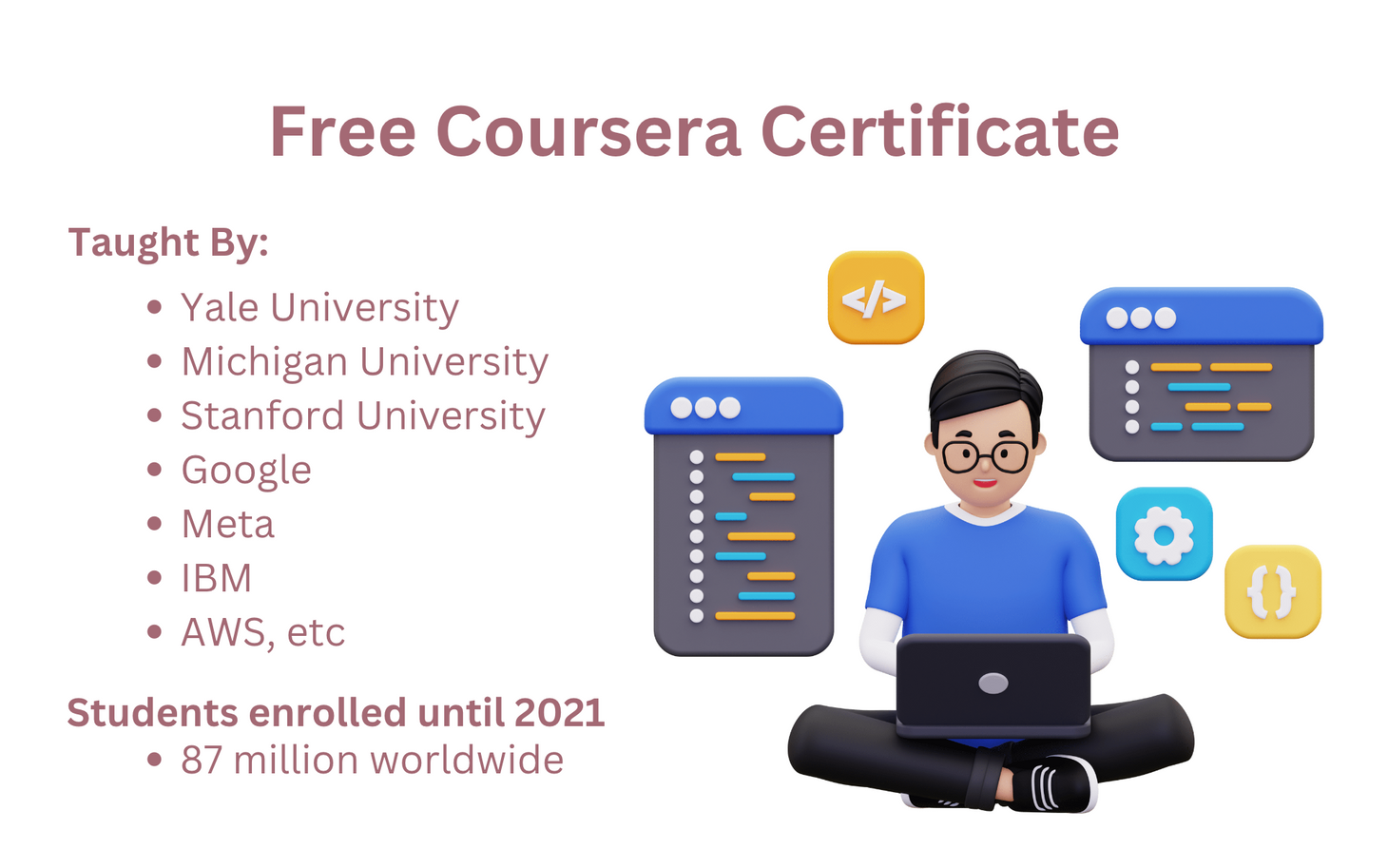
Coursera free courses are online courses available via audit access at no cost, giving you full access to lecture videos, readings, and ungraded practice quizzes. They are created by faculty at accredited universities and industry leaders at top companies, and cover thousands of topics across technology, business, health, personal development, and the arts.
To access free courses, create a free Coursera account, search for your target course, and select the “Audit for Free” enrollment option (not the default “Enroll for a Certificate” option, which will prompt you to enter payment details). You can also filter the course catalog by “Free” to see only courses with audit access available.
By default, free audit access does not include a shareable certificate. However, you can apply for Coursera Financial Aid, which covers 100% of the certificate cost for learners who demonstrate financial need, with approval typically taking 15 days. Some courses also offer free limited-time certificates during promotional periods, so check the course page for current offers.
Yes, free Coursera courses are worth it for job seekers, especially when paired with tangible proof of skill (e.g., a portfolio of projects you built during the course). A 2025 Coursera Impact Report found that 78% of hiring managers recognize and value Coursera professional certificates, and many entry-level roles list Coursera certificates as acceptable credentials for applicants without formal degrees.
No, free audit courses do not have time limits — you can access course materials for as long as the course is hosted on Coursera (most courses remain available for 2-5 years after their initial launch). You can learn at your own pace, pausing or returning to the course whenever it fits your schedule.
Yes, the core course content (lecture videos, readings, practice quizzes, and discussion forums) is identical for free audit learners and paid learners. The only differences are that free audit learners do not have access to graded assignments, proctored exams, or shareable certificates.
Coursera’s free courses are one of the most accessible, high-quality no-cost learning resources available in 2026, whether you’re looking to upskill for a new career, explore a personal interest, or test a new field before investing in expensive training. With thousands of courses designed by top universities and industry leaders, flexible self-paced learning, and no financial barrier to entry, there’s no downside to enrolling in a free course today.
To get started, browse Coursera’s free course catalog, pick a topic aligned with your personal or professional goals, and enroll in the audit option to start learning immediately. If you’re interested in earning a shareable certificate, apply for financial aid to cover the cost at no expense to you. Ready to unlock your potential with no-cost learning? Head to Coursera’s free course library now to find your first course, and take the first step toward building new skills today.

Ms.Sultana brings over 16 years of expertise working with global Clients by providing different skills and Services. For the last 5 years working as an Affiliate marketer, specializing in high-ticket campaigns that drive exponential growth. She holds a degree in Computer Science and Engineering as well as achieved many more skills certificates from different institute/academies/Platform. As part of the Elite Global Marketing team, Sultana has helped clients generate millions in revenue through strategic partnerships, innovative funnels, and data-driven insights.









You’re drowning in email, your calendar is chaos, and you wonder how to manage virtual assistants remotely without spending all day managing them. Most guides…
Managing a virtual assistant doesn’t require a rigid playbook, it requires the right framework for your specific situation. If you’ve ever struggled with…
 Image source: Bing (Web (fairuse with source credit)) how to…