⚠️ Disclosure: This post contains affiliate links. We may earn a commission at no extra cost to you.
⚠️ Disclosure: This post contains affiliate links. We may earn a commission at no extra cost to you.

Learning from top universities and industry leaders no longer requires a big budget. Coursera gives you free access to thousands of courses if you know where to look and which options to click. Whether you want to switch careers, deepen your knowledge, or simply explore a new subject, this guide shows you exactly how to use Coursera at no cost—with practical steps, hidden features, and honest trade-offs that turn a free account into a powerful growth tool.
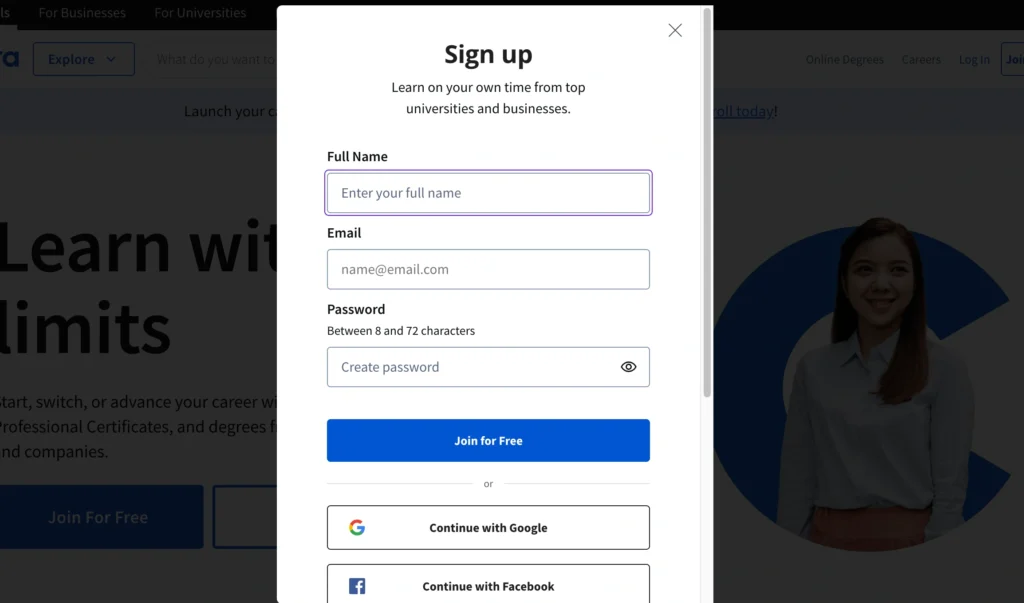
Most courses offer a free “audit” link right on the enrollment page.
Coursera partners with universities and companies such as Yale, Google, and IBM to deliver courses, Specializations, and Professional Certificates. Not everything is free, but the platform deliberately keeps a generous amount of content open to everyone.
The most important distinction is between paying for a full experience and taking a course in “audit” mode. When you audit, you get nearly all the learning material—video lectures, readings, discussion forums—but you won’t receive a certificate or access graded assignments. For many learners, that is a fantastic trade-off because the knowledge still flows freely. In addition, Coursera offers financial aid for those who cannot afford the paid features, plus free guided projects where you practice tangible skills inside a browser-based environment. Together, these options make it possible to build an entire learning path without opening your wallet.
Before diving in, a detailed breakdown of what the platform provides is worth reading to understand the full range of paid and free content.
The fastest way to surface free courses is to use the platform’s built-in filter. On the main catalog page, type a subject you care about, then open the “Price” filter and select Free. Instantly, the results narrow to courses that won’t cost you anything. This filter works on both desktop and mobile.
Alternatively, you can browse popular free courses directly from the Explore section or head to curated lists that Coursera often updates. Some of the most enrolled free courses include Learning How to Learn, Programming for Everybody (Getting Started with Python), and The Science of Well-Being—all from world-class institutions.
Pay attention to the course enrollment button. Even when a course lists a price, there’s frequently an audit path. In practice, clicking “Enroll for free” often reveals a small “Audit the course” link at the bottom of the pop-up window. That link is easy to miss, so slow down and scan the full screen. Choosing audit instantly unlocks the course materials and keeps everything at zero cost.
Auditing a course means you access the same video lectures and readings as paying learners. You participate in discussion forums and learn at your own pace. The only things that remain locked are the graded quizzes (sometimes you can view them) and the certificate.
Here are the key differences:
| Feature | Audit (Free) | Paid Enrollment |
|---|---|---|
| Video lectures | ✅ | ✅ |
| Readings & resources | ✅ | ✅ |
| Discussion forums | ✅ | ✅ |
| Graded assignments | ❌ | ✅ |
| Certificate of completion | ❌ | ✅ |
| Unlimited access after the course ends | No (access may expire) | Yes |
A common mistake is assuming that auditing feels like a second-class experience. In reality, millions of audit learners successfully complete courses and apply the knowledge directly to their work or personal projects. If you later decide you need a certificate for your résumé, you can often pay to upgrade within the same course.
To start auditing, find a course you like, click Enroll for free, and when the options appear look for the Audit link at the bottom. Once enrolled, all the content appears just as it would for a paid learner—minus the gradebook.
If you need graded assignments and the certificate but cannot afford the fee, Coursera’s financial aid program is built for you. You can apply for aid on individual courses or entire Specializations.
The application process is straightforward. On the course page, scroll down until you see the Financial aid link (often near the enrollment button). You’ll fill out a short form explaining your educational goals and why the financial assistance matters. Be genuine and specific—mention the skills you want to build and how they connect to your current situation. You’ll also need to confirm that you cannot pay the full fee. Coursera typically reviews applications within 15 days, and once approved, you unlock the full paid experience, including certificates.
Keep in mind that financial aid is not a one-click coupon; it requires patience. If you plan to complete multiple courses, apply early so the review time doesn’t delay your schedule.
While Coursera Plus requires a subscription, you can skip it and take individual courses free through auditing or financial aid.
Many learners don’t realize that Coursera offers free Guided Projects under its project network. These are bite-sized, hands-on tutorials that run in your browser. You follow an instructor step-by-step to complete a real task, like creating a data visualization in Tableau or building a simple web page with HTML and CSS.
Search for “Guided Project” in the catalog and use the price filter to show free options. The typical project takes 1–2 hours and gives you a concrete output you can add to a portfolio. Because these projects bypass the traditional lecture setup, they’re perfect for cementing the fundamentals of skill building through active practice. No download, no software setup—just a browser and some curiosity.
If you’re aiming for recognized certificate programs later, free guided projects are an excellent way to sample a topic before committing to longer courses.
The Coursera app turns spare minutes into learning sessions. It is available for iOS and Android, and supports all the free features found on the desktop site.
Two app-specific benefits stand out. First, you can download videos and readings for offline access—ideal for commutes or areas with spotty internet. Second, the app’s clean interface makes it effortless to browse free courses quickly. Use the same price filter in the search bar, enroll in audit mode, and all content syncs across your devices.
One practical tip: enable push notifications for course deadlines (even free audit courses sometimes show suggested timelines). These gentle nudges help you stay consistent, and consistency often matters more than raw motivation when you are learning independently.
Free learning doesn’t mean skimming. The most successful free learners treat courses with the same seriousness as a paid class. A few strategies make a noticeable difference.
Also, remember that learning is only half the equation. Employers want to see what you can do. Publish your projects on GitHub, share a write-up on LinkedIn, or document your progress in a personal blog. You can even turn your insights into a growing collection of learning guides to build your personal brand.
If at any point you find yourself overwhelmed, remind yourself that you don’t need to finish every course. Free access means you can afford to sample multiple topics until you find the one that clicks.
Free learning comes with a few hidden traps. Avoid these to keep your momentum strong.
No, certificates require payment or an approved financial aid application. Auditing provides full access to course materials but does not include a certificate. Financial aid, if granted, unlocks the certificate at no cost.
Visit the course page, scroll down to “Financial aid,” and complete the application. Explain your circumstances honestly. Approval typically takes up to 15 days, and you’ll receive an email when it’s ready.
Most individual courses offer audit access, but some Specializations and Degree programs do not. Always check the enrollment pop-up after clicking “Enroll for free.” If the audit link does not appear, the course may not support free access.
Yes. Using the Coursera mobile app, you can download video lectures and readings for offline viewing. This works perfectly in audit mode and is a lifesaver for busy schedules.
It varies. Many courses give you access for the duration of the session plus a short grace period. To be safe, download important materials while you’re actively enrolled.
Yes, the core learning materials—videos, articles, and forums—are identical. The main difference is that audit learners cannot submit graded assignments or earn certificates.
Watch a step-by-step video guide to see how to enroll and audit a course in real time.
Coursera’s free tier is not a trial; it’s a genuinely powerful learning environment if you use it with intention. By mastering the audit option, applying for financial aid when needed, and leveraging free Guided Projects, you can build serious skills without spending a single dollar. The platform continues to evolve, carrying courses from Coursera’s university partners into 2026 and beyond—so the opportunities are only growing.
Start with one course today. Use the price filter, click that audit link, and commit to just one video module. Small, consistent steps will turn free access into real-world expertise that can reshape your career and confidence.

Ms.Sultana brings over 16 years of expertise working with global Clients by providing different skills and Services. For the last 5 years working as an Affiliate marketer, specializing in high-ticket campaigns that drive exponential growth. She holds a degree in Computer Science and Engineering as well as achieved many more skills certificates from different institute/academies/Platform. As part of the Elite Global Marketing team, Sultana has helped clients generate millions in revenue through strategic partnerships, innovative funnels, and data-driven insights.












You’re drowning in email, your calendar is chaos, and you wonder how to manage virtual assistants remotely without spending all day managing them. Most guides…
Managing a virtual assistant doesn’t require a rigid playbook, it requires the right framework for your specific situation. If you’ve ever struggled with…
 Image source: Bing (Web (fairuse with source credit)) how to…