⚠️ Disclosure: This post contains affiliate links. We may earn a commission at no extra cost to you.
⚠️ Disclosure: This post contains affiliate links. We may earn a commission at no extra cost to you.

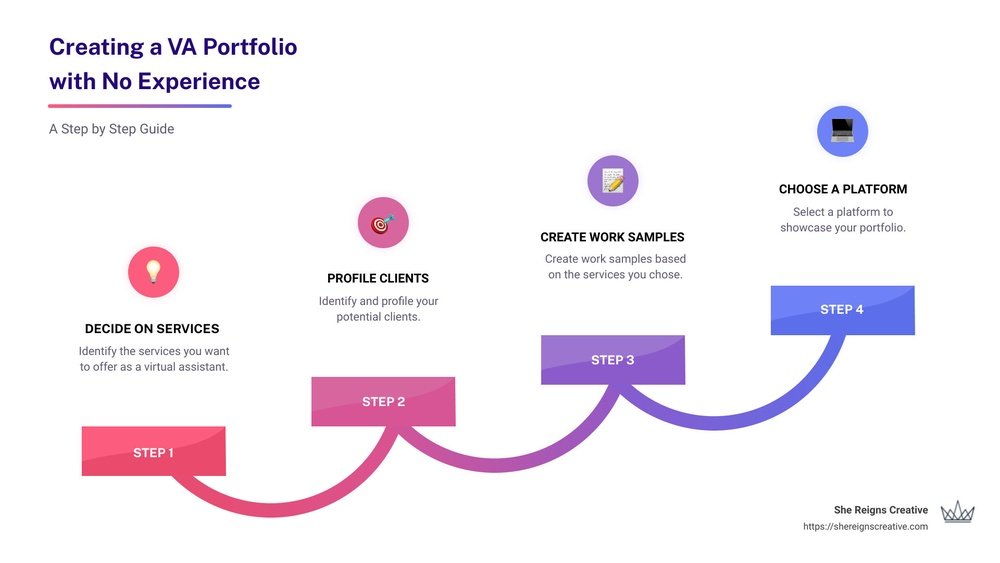
A virtual assistant portfolio is more than a collection of past tasks. It is the single most persuasive tool you have to convert a curious visitor into a paying client. Decision-makers often scan dozens of profiles; yours must immediately communicate reliability, specialised skill, and a clear understanding of their operational pain points.
Building that asset requires deliberate choices about what to include, how to structure it, and how to keep it visible. This guide walks through each decision in practical detail, from defining your service focus to promoting the finished portfolio where ideal clients already spend their time.
A portfolio that tries to appeal to everyone usually persuades no one. Business owners searching for support want a specialist who already understands their industry’s rhythms, terminology, and common friction points. Selecting a niche before you build anything gives every subsequent choice—design, sample projects, written tone—a clear direction.
Start by separating what you can do from what you should offer commercially. Create two columns: one for hard, measurable skills (calendar management, CRM administration, invoice reconciliation, podcast editing, Canva design) and another for soft strengths (anticipating needs, handling urgent re-prioritisation, communicating across time zones).
Look for the intersection where proficiency meets genuine enjoyment. In practice, a common mistake is listing every platform you have ever opened. A lean list of tools you can navigate confidently under pressure reads as far more credible than a long, shallow inventory. If you have completed any structured training, reference it briefly in your bio rather than cluttering the skills section—formal credentials strengthen the perception of reliability.
Validate your chosen focus against real buyer behaviour. Spend time on freelance marketplaces, VA-specific job boards, and LinkedIn job posts. Note which service categories appear consistently and which receive detailed, urgent briefs. A niche with steady, recurring demand—such as executive email and diary management, e-commerce operations support, or real estate transaction coordination—offers a more predictable pipeline than a trendy service that spikes and fades.
Also observe what clients complain about in reviews of other assistants. Those frustrations often point directly to portfolio content you can build: a case study proving you solve exactly that problem.
The platform you choose dictates how professionally your work is perceived and how easily clients can navigate it. Each option involves a trade-off between control, discoverability, and maintenance effort.
A dedicated website gives you full ownership over your brand presentation. Modern builders such as Wix, Squarespace, and WordPress.com offer portfolio-specific templates that require no coding. You can structure a logical flow: homepage introduction, services overview, detailed case studies, and a contact form.
The primary advantage is trust. A custom domain and polished layout signal permanence, which matters to clients hiring for ongoing relationships. The trade-off is that you are responsible for driving all traffic to the site—it will not generate discovery on its own. For many established VAs, this becomes the central hub where all other promotional efforts ultimately point.
Platforms like Upwork, Fiverr, and Freelancer embed portfolio features directly into your profile. The benefit is built-in visibility: clients are already searching with intent to hire. Your project history, client ratings, and response statistics all contribute to how the platform’s algorithm ranks you in search results.
The limitation is reduced control. Your portfolio sits inside a standardised template, and you compete directly on visible metrics like hourly rate and review scores. This environment works best for VAs who are building an initial client base and want to accumulate verifiable feedback quickly.
LinkedIn functions as a de facto professional portfolio for many virtual assistants. The Featured section accepts media uploads, links to case studies, and document attachments—use it to display exactly the same curated evidence you would place on a standalone site. Recommendations from past collaborators function as embedded testimonials visible to anyone viewing your profile.
Instagram and Facebook can supplement this for VAs in visually-oriented niches like social media management or brand design, but they work better as traffic channels than as primary portfolios. Their content feeds are chronological and ephemeral; a client researching your capabilities benefits from a static, structured presentation of your best work.
The profile section is not just an introduction—it is a conversion page. Every sentence should move a reader from mild curiosity toward the conviction that contacting you is a low-risk, high-reward decision.
Lead with the outcome you create, not your job title. Instead of “I am a virtual assistant,” open with something like “I help consulting firm principals reclaim 15+ hours a week by managing client scheduling, travel logistics, and invoice follow-up.” That single sentence clarifies who you serve, what you do, and the concrete benefit.
Keep the entire bio under 150 words. Structure it in three short paragraphs: who you help, how you work, and what makes your approach different. Write in a natural conversational register—stiff corporate language creates distance, while overly casual writing can feel unprofessional. Read it aloud; if any sentence feels awkward to say, rewrite it.
Organise skills into logical clusters rather than a single undifferentiated list. Group technical proficiencies (software, platforms, tools) separately from service categories (inbox management, research, data entry, customer support). This helps a prospect scanning quickly to confirm you handle the specific task they need filled.
Use a simple visual format such as a two- or three-column grid or clearly spaced bullet points. Avoid progress bars or percentage ratings for soft skills—stating you are “90% reliable” inadvertently suggests a 10% gap.
A clear, well-lit headshot with a plain or blurred background performs consistently better than casual selfies or heavily filtered images. Wear what you would wear to a client video call: neat, simple, and appropriate to your target industry.
If your work is visibly creative—graphic design, presentation building, social media content—consider including one secondary image of you working in context, such as at an organised desk with relevant tools visible. Avoid stock photography; it undermines the personal trust your portfolio is meant to build.

A deliberate portfolio structure, with samples and notes mapped out before building begins, saves hours of revision later.
Telling a client you are skilled is far weaker than showing them evidence. The most compelling portfolios let the work speak through concrete examples, structured narratives, and third-party validation.
Select three to five projects that collectively demonstrate your range while staying within your niche. Each entry needs context: the client’s industry, the original challenge, your specific role, and the toolset you used. Where confidentiality restricts you from sharing real client materials, create a redacted version or build a representative sample with fictitious data—labelled clearly as a demonstration.
Prioritise recency. A project completed six months ago using current software carries more weight than one from three years ago that relied on a tool no longer widely used.
A case study transforms a simple portfolio entry into a persuasive story. Follow a consistent three-part structure: Situation (what problem the client faced), Action (what you specifically did to address it), and Result (what measurable outcome followed). Even a single quantified result—hours saved, response time reduced, backlog cleared—elevates the entire entry.
Keep each case study between 150 and 300 words. Use subheadings to break the narrative into scannable sections. If you lack a formal metric, describe the qualitative shift in the client’s words, excerpted from feedback they gave you.
Testimonials carry disproportionate weight because they are third-party endorsements. Request them soon after a successful engagement, while the client’s enthusiasm is fresh, and ask permission to attribute them by first name, role, and company.
Place each testimonial adjacent to the project it references. A standalone testimonials page is less effective because it requires the reader to mentally reconnect each quote with the relevant work—reduce that friction by pairing them directly. A short, specific quote (“She restructured my inbox from 3,000+ unread to a clean system I can actually maintain”) outperforms a generic compliment every time.
Building the portfolio is only half the work. A brilliant showcase that nobody finds produces the same result as no portfolio at all. Basic search visibility and ongoing measurement turn your asset into a client-generating engine.
Search engines need clear signals about what each page contains. Write a descriptive page title that includes your name and primary service—something like “Executive Virtual Assistant Portfolio | Jane Doe.” Use distinct, informative headings on each page so that both visitors and search crawlers can grasp the structure at a glance.
Add descriptive alt text to every image. This matters for accessibility and provides additional context that helps pages surface in image search results. Ensure your site loads quickly; page speed remains a confirmed ranking factor, and a sluggish site frustrates mobile visitors.
Identify the exact phrases prospective clients type when searching for someone like you. Long, specific terms such as “real estate virtual assistant portfolio” or “Kajabi course management VA” face less competition than broad terms and attract visitors with clearer intent.
Weave these phrases naturally into your page headings, project descriptions, and the first 100 words of your bio. Structured data markup—technical vocabulary for how content is labelled in code—can help search engines understand your portfolio’s elements, though this is an advanced step worth exploring once your basics are solid. Avoid overloading any single sentence with multiple keywords; readability always takes priority.
Install a lightweight analytics tool, such as Google Analytics, to understand visitor behaviour. Monitor which pages receive the most views, how long visitors stay, and which projects generate the most inquiry-form submissions or clicks on your contact link.
Patterns in this data reveal what to adjust. If a particular case study receives high traffic but low conversion, its call to action may need strengthening. If mobile visitors bounce rapidly, your layout probably needs a mobile-first review. Treat analytics as a feedback loop: observe, hypothesise a change, implement it, and measure again.

A portfolio that appears polished and fully functional on every device signals professionalism before the visitor reads a single word.
A static portfolio gradually loses relevance. The tools you list become outdated, older projects no longer represent your current capabilities, and dormant pages suggest inactivity. Regular maintenance protects the credibility you have built.
Review your portfolio quarterly. Remove any project older than two years unless it demonstrates a skill that remains central to your offering and no newer example exists. Check every external link—to tools, platforms, or referenced resources—to confirm they still resolve correctly. Proofread all text, as minor typos introduced during updates can linger and erode perceived attention to detail.
Whenever you complete a significant engagement or learn a new platform that matters to your niche, add it to the portfolio within two weeks. Timeliness matters: a recent addition signals an active, growing practice. When adding a skill, consider whether an old, less relevant one can be removed to keep the focus sharp.
Ask a trusted peer, mentor, or even a past client to spend five minutes on your portfolio and answer one question: “What’s unclear or what’s missing?” Outside perspectives catch blind spots—a confusing navigation label, a missing detail on your contact page, a bio that sounds generic rather than specific. Implement the most actionable suggestions and repeat the process once a year.
Promotion is not bragging; it is giving potential clients the opportunity to discover that someone with your expertise exists. A strategic, low-pressure approach works more effectively than sporadic bursts of self-promotion.
Join online communities where your ideal clients seek advice. This might be industry-specific Slack groups, Facebook communities for small business owners, or professional forums. Contribute helpful, substantive responses without immediately linking to your portfolio. Over time, a helpful presence builds recognition, and your profile—where your portfolio link lives—becomes a natural next click for curious readers.
Virtual events and webinars offer similar opportunities. When a presenter asks attendees to introduce themselves in chat, a concise line about your specialty plants a seed without hard selling.
If you maintain a small list of contacts—past clients, warm leads, professional acquaintances—send a brief quarterly update. Highlight one recent project or a new service capability and include a direct link to your portfolio. Keep the message short, specific, and genuinely useful. The goal is staying top-of-mind so that when someone in their network mentions needing support, your name surfaces first.
Choose one or two platforms where your target clients actively participate and focus your energy there. Share practical insights drawn from your work: a tip for managing meeting overload, a quick tutorial on a tool you use daily, a simple before-and-after of an organised workflow. Authentic demonstration content consistently builds more trust than generic motivational posts.
When a visitor arrives at your portfolio from a social media post they found helpful, they arrive pre-warmed—already inclined to believe you know what you are doing.
If you are still refining exactly which services to feature, taking a step back to assess your strongest professional capabilities can sharpen your portfolio’s focus. Business owners consistently look for assistants who bring the right blend of reliability and initiative, so make sure your portfolio proves both. Once you start working with clients, building a system to manage collaborative work efficiently helps you deliver the results that future case studies will feature.
Thoughtfully structuring your portfolio pages also dovetails with broader web visibility principles; the same techniques that make a website easy for visitors to navigate apply directly to your case study layouts. If you want to explore additional ways to strengthen your offering, browsing structured learning paths with recognised credentials can give you fresh material to add to your portfolio immediately.

A clean, logically organised portfolio layout helps visitors scan your full range of capabilities in under a minute.
A VA portfolio is a curated collection of work samples, case studies, client testimonials, and professional credentials that demonstrates your virtual assistant capabilities to prospective clients. It serves as evidence of your expertise rather than just a claim.
Include three to five well-documented examples, even if some are pro bono work, simulations, or projects from previous employment. Quality and clear explanation of your specific contribution matter far more than quantity.
Yes. Use volunteer work, projects completed during training, or self-initiated demonstrations labelled as samples. Frame each around the problem it solves and the skill it proves, and be transparent about its origin.
Perform a full review every quarter. Add significant new projects or skills within two weeks of completion. Remove outdated examples that no longer represent your current service level.
A LinkedIn profile works well as a starting point, especially when you use the Featured section to display case studies and testimonials. A dedicated website provides greater control over presentation and is worth building once you have enough material to justify a standalone hub.
Creating a VA portfolio that consistently attracts clients is a methodical process, not a one-time creative exercise. Start with a clear niche, choose a platform that aligns with how you plan to promote yourself, and build every section—bio, skills, case studies, testimonials—to answer the central question in a client’s mind: “Can this person solve my specific problem?”
Once the portfolio is live, treat it as a living document. Update it with fresh evidence, monitor how visitors interact with it, and refine what does not work. The most successful virtual assistant portfolios are never truly finished; they evolve alongside the professional who owns them.
Build yours with the same care you would apply to a client project. The return on that investment compounds with every new visitor who leaves convinced you are the right person to hire.

Sofia Grant is a business efficiency expert with over a decade of experience in digital strategy and affiliate marketing. She helps entrepreneurs scale through automation, smart tools, and data-driven growth tactics. At TaskVive, Sofia focuses on turning complex systems into simple, actionable insights that drive real results.










You already have the skills to support busy professionals—but turning those skills into a steady stream of clients takes intentional marketing…
A career as a virtual assistant gives you the freedom to work from anywhere, set your own hours, and build a business around skills you already have—or…
The virtual assistant industry has matured dramatically. What once meant “remote admin support” now spans high-ticket specialties like launch…