⚠️ Disclosure: This post contains affiliate links. We may earn a commission at no extra cost to you.
⚠️ Disclosure: This post contains affiliate links. We may earn a commission at no extra cost to you.

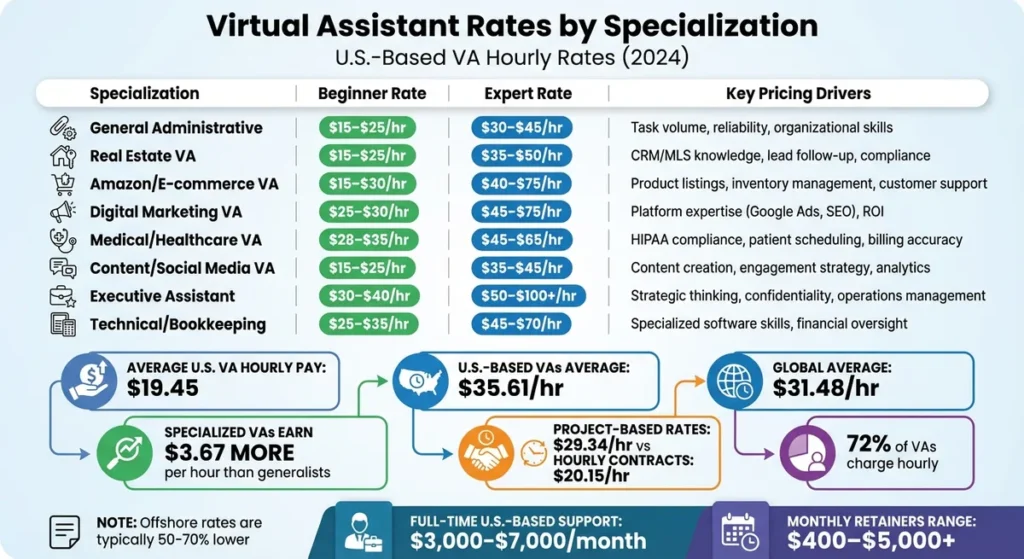
If you've ever stared at a quote of $500 a month, you probably wondered if it was fair. Understanding virtual assistant rates for entrepreneurs is the fastest way to stop overpaying.
You need to match cost to risk. A simple email task costs less than strategic support. Per our research, global averages vary wildly by skill.
Let's break down the real numbers.
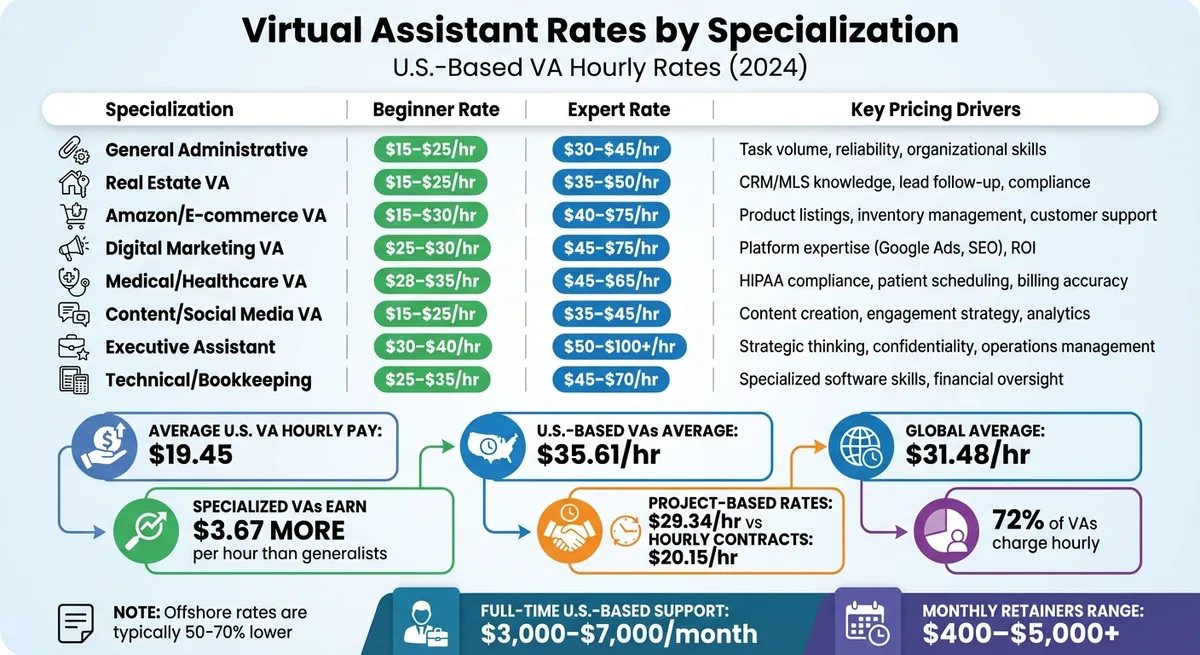
Virtual assistant rates depend on skill and location. In the US and UK, you pay $25 to $100 per hour. In the Philippines or Eastern Europe, rates drop to $5 to $25.
Most entrepreneurs hire for a monthly retainer. This usually ranges from $500 to $2,000 per month.
The biggest mistake is thinking hourly rate equals total cost. It does not. You must look at the total management burden.
A cheap hire often costs more because you spend hours checking their work.
There are three main pricing models.
Most successful founders prefer retainers. It keeps the VA motivated and focused. As of 2026, the "hourly illusion" is fading.
Fixed costs are becoming the standard.
We aggregated data from major freelance platforms and agency reports. The numbers below reflect the current market.
| Experience Level | US/UK Rate | Global Rate (PH/EE) |
|---|---|---|
| Junior | $15 – $25/hr | $5 – $15/hr |
| Mid-Level | $25 – $50/hr | $10 – $25/hr |
| Senior | $50 – $100+/hr | $20 – $40/hr |
These are rough benchmarks. Specialized skills push rates higher. General admin stays at the bottom.
Choosing who to hire matters more than the price tag. Each option has distinct trade-offs.
This is the most common route for startups. You save money, but you take the risk. If the VA gets sick or quits, you start over.
Agencies charge a premium, usually 20% to 40% higher. They provide a dedicated team and a supervisor.
You only consider this if you are growing fast. You pay local wages and benefits.

Comparison Table
| Feature | Freelancer | Agency | In-House |
|---|---|---|---|
| Cost | Low | Medium-High | High |
| Speed to Start | 1-2 Weeks | 1 Week | 4-6 Weeks |
| Accountability | You | Agency | You |
| Flexibility | High | Medium | Low |
You pay for outcomes, not hours. A VA who answers email is not the same as one who manages complex sales funnels.
This includes email, scheduling, and travel bookings. The barrier to entry is low. Rates stay low.
You should expect to pay $10 to $20 globally.
This involves CRM hygiene, automation, and report building. These VAs need specific technical skills. Rates jump to $20 to $40 globally.
If they know Zapier or HubSpot, you pay more.
This is the top tier. They handle strategic planning and high-stakes communication. They need years of experience.
Expect to pay $50 to $100+ in the US/UK. This is about the role of an executive assistant, which requires deep business context.
Why does a $5/hr VA often feel like a $25/hr hire? It is the management tax. You spend three hours explaining a simple task.
You spend two hours fixing their mistakes.
That is a lot of lost time. Your time is worth far more than $5.
Cheaper VAs often leave for better opportunities. When they leave, you lose institutional knowledge. You spend a week re-training the next person.
This cycle repeats constantly.
Low-cost hires often lack proper protocols. They might share passwords or leave documents open. This is a massive security risk.
To mitigate this, review our guide on virtual assistant security and compliance.
The math is simple. A mid-level VA at $15/hr saves you 5 hours of your own time a week. That is a net gain.
A junior VA at $5/hr who costs you 10 hours of your time is a net loss.
A good hire fails without a clear process. You must define the scope before you spend a dime.
Do not write "manage my calendar." Write "Manage the calendar using Calendly and sync it with Salesforce." Specificity prevents scope creep. Look at this list of essential VA tasks to get ideas for your specific role.
Always test a candidate. Offer a 10-hour paid trial. This is not free work.
It is a low-risk evaluation. You check their communication and output. You verify they can actually do the job.
Create Standard Operating Procedures (SOPs) before they start. Record a video for every recurring task. This reduces your need for daily management.
Use tools like Notion or Slack. Check out these free resources for setting up workflows.
Meet once a week. Review key metrics. Focus on error rates and response times.
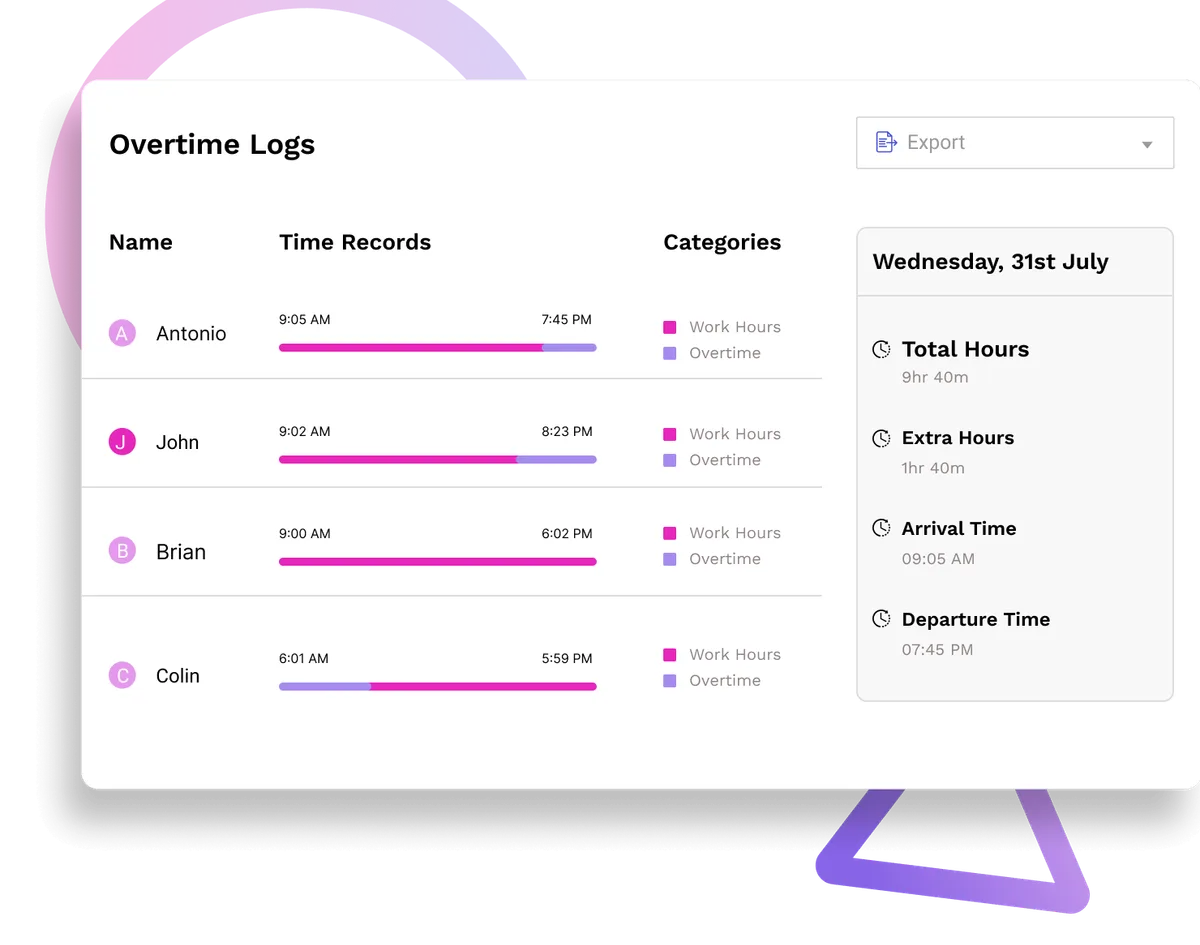
Track their hours accurately using time tracking software. This ensures you are paying for results, not just activity.
You cannot skip this step. Missteps here can trigger IRS penalties or data breach lawsuits.
The IRS uses behavioral and financial control tests to classify workers. If you dictate exact hours and provide equipment, you may be required to treat the VA as an employee. This triggers payroll taxes, benefits, and state unemployment coverage.
See the IRS independent contractor rules for the full behavioral test.
Have every VA sign a Non-Disclosure Agreement before they touch sensitive data. Include a "work-for-hire" clause so you own all deliverables. Without this language, the VA can claim copyright over the content they produce.
If you serve EU or California customers, GDPR and CCPA apply. Limit data access to only what the VA needs. Use a password manager with revocable access.
Terminate credentials immediately upon offboarding.

Different business models require different pricing strategies. Here is how three common setups play out.
A marketing agency owner hires one mid-level VA at $15/hour for 10 hours a week. Total cost: $600 per month. The founder reclaims about 12 hours weekly because the VA handles inbox triage, calendar, and scheduling.
The founder spends roughly 30 minutes daily managing the VA. Net gain: about 10 productive hours a week. Key lesson: budget for a paid trial and solid SOPs before scaling hours.
A Shopify seller scales support from 3 to 6 VAs during Black Friday. Each VA works a 30-hour weekly retainer at $20/hour. Total monthly cost: $3,600.
Support tickets dropped from 8-hour to 45-minute average response times. The owner built clear handoff protocols to prevent order overlaps. Key lesson: flexible retainers beat hourly billing during demand spikes.
A Series A startup hires a senior fractional operations VA at $3,500 per month. The VA owns CRM, reporting, and executive scheduling. The CEO saves 20+ hours weekly.
Key lesson: premium pay buys focus and accountability, not just labor. For a full breakdown of what these roles include, see the key admin outsourcing tasks.
For a 40-hour week, a mid-level VA typically earns $1,000 to $2,000 monthly in the US or UK. In the Philippines, expect $800 to $1,500. Senior specialized VAs can command $4,000 to $5,000+ regardless of location.
Rates should reflect skill depth and scope, not just hours logged.
On hourly contracts, you typically do not. On monthly retainers, sick days and holidays are usually included in the flat rate. Always state this in the written agreement before signing.
Ambiguity here is the most common source of billing disputes between founders and VAs.
Plan for $50 to $150 monthly per VA for core tools like Slack, Notion, Asana, and a time tracker. Add specialized software costs like HubSpot or a CRM if the VA needs them. Some platforms charge per-seat fees, so factor this into the total cost per hire.
Consider the switch once you are managing three or more freelancers, or when one VA leaving causes business disruption. Agencies add a 20% to 40% premium but provide backup coverage, structured onboarding, and a point person. If reliability matters more than raw cost, the upgrade pays for itself.
Run a paid 10-hour trial on one real task from your actual workflow. Ask for three references from current clients. Check for certified credentials where relevant, like HubSpot or Salesforce certifications.
Red flags include vague portfolios, refusal to share samples, or resistance to a paid trial.





















how to create SOPs for virtual assistants is harder than it sounds. You’ve got one VA handling email, another doing bookkeeping, and a third managing social…
The problem most founders face isn’t hiring the wrong person, it’s giving them work that lives nowhere concrete. If you’ve ever wondered how to manage virtual…

How to communicate with a virtual assistant effectively comes down to one simple truth: these systems aren’t mind readers. They’re patternmatching machines…