⚠️ Disclosure: This post contains affiliate links. We may earn a commission at no extra cost to you.
⚠️ Disclosure: This post contains affiliate links. We may earn a commission at no extra cost to you.

Choosing the right online learning platform can feel overwhelming. You want a site that fits your goals, budget, and learning style.
That’s why comparing Alison vs Coursera matters. Both offer tons of courses, but they work very differently. By the end of this article, you’ll know which one matches your needs best. Ready to find the perfect fit for your education?
Let’s dive in.
Choosing the right online learning platform can shape your education journey. Alison and Coursera are two popular options, each with unique features. This section compares both platforms across key areas. It helps understand their strengths and differences clearly.
Coursera is an online learning platform founded in 2012. It partners with top universities and companies worldwide. Coursera offers courses, professional certificates, and degree programs.
Key features of Coursera include:
Courses on Coursera often include video lectures, quizzes, peer-graded assignments, and hands-on projects. The platform suits learners aiming for in-depth study and recognized credentials. Coursera also offers financial aid to eligible students.
| Feature | Description |
|---|---|
| Course Types | University courses, professional certificates, degrees |
| Partners | Top global universities and companies |
| Access | Web and mobile apps |
| Certification | Paid certificates, degrees |
Alison is a free online learning platform founded in 2007. It focuses on workplace skills and general education. Alison offers many free courses with optional paid certificates.
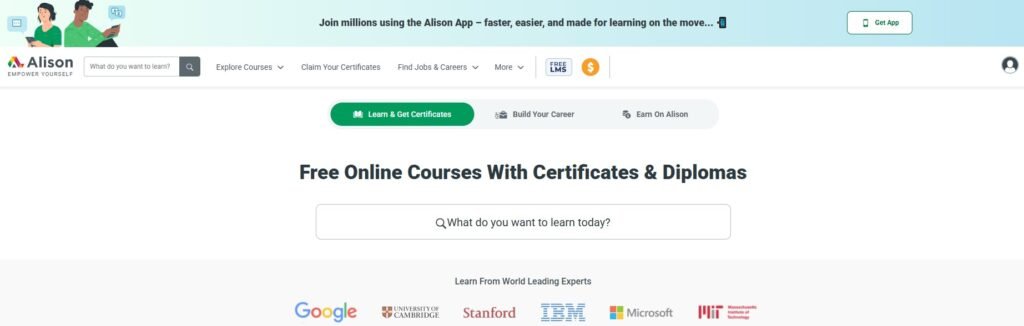
Image: Alison Free Courses
Features of Alison include:
Alison is ideal for learners wanting quick skill upgrades or basic knowledge. The platform supports self-paced learning with simple course structures. It also offers learning paths for career development.
| Feature | Description |
|---|---|
| Course Types | Free courses, diplomas |
| Focus | Workplace and practical skills |
| Access | Web platform |
| Certification | Optional paid certificates and diplomas |
| Courses Name | Courses Link |
|---|---|
| Alison Certificate Courses | Check Course with click this link |
| IT Courses | Check Course with click this link |
| Health Courses | Check Course with click this link |
| Language Courses | Check Course with click this link |
| Engineering and Construction Courses | Check Course with click this link |
| Education Courses | Check Course with click this link |
| Personal Development Courses | Check Course with click this link |
| Business Courses | Check Course with click this link |
| Management Courses | Check Course with click this link |
| Carrer Guide | Check Course with click this link |
Both platforms offer a broad range of courses, but their focus differs. Coursera emphasizes academic and professional topics. Alison focuses on practical and vocational skills.
Coursera’s course variety:
Alison’s course variety:
Coursera offers deep learning paths and degrees in many fields. Alison provides many short courses focused on skill-building. Both platforms cover popular subjects like business and IT.
Course offerings differ in depth and structure. Coursera’s courses often last weeks or months. They include video lectures, assignments, and exams. Many courses lead to professional certificates or degrees.
Alison offers shorter courses that learners can complete quickly. Most courses are self-paced with quizzes and simple assessments. Diplomas require completing a series of courses.
| Aspect | Coursera | Alison |
|---|---|---|
| Course Length | Weeks to months | Hours to days |
| Course Format | Video lectures, assignments, projects | Video lessons, quizzes |
| Assessment | Peer-graded, quizzes, exams | Quizzes |
| Certification | Professional certificates, degrees | Certificates, diplomas |
Certificates add value to completed courses. Coursera certificates are often recognized by employers and universities. Some courses offer accredited certificates and official university degrees.
Alison certificates are less formal but useful for skill proof. They can be downloaded or ordered as physical copies. Diplomas add more recognition than basic certificates.
Coursera’s certificates often enhance resumes or LinkedIn profiles. Alison certificates show completion and basic competence. Degree certificates from Coursera hold the highest recognition.
Certification options vary by platform and course type. Coursera offers:
Alison provides:
Checkout Alison Sales and Marketing Courses
Coursera’s options include verified certificates requiring identity checks. Alison’s certificates focus on accessibility and affordability. Degree certifications are exclusive to Coursera.
Pricing differs significantly between Alison and Coursera. Alison offers free access to all courses. Certificates and diplomas require payment.
Coursera has a mix of free and paid courses. Many courses require payment for certificates. Degree programs cost significantly more.
| Platform | Free Access | Paid Certificates | Degree Programs |
|---|---|---|---|
| Alison | Yes, all courses | Optional, low cost | No |
| Coursera | Some courses | Yes, varies by course | Yes, expensive |
Alison suits learners on a tight budget. Coursera suits those seeking accredited credentials or degrees.
Alison pricing is straightforward:
Coursera pricing varies by course and program:
Coursera offers monthly subscriptions for continuous learning. Alison uses a pay-per-certificate model. Degree programs require full payment upfront or installments.

Credit: daninstitute.com
The learning experience on Alison and Coursera varies significantly, impacting how students absorb and apply knowledge. Both platforms offer diverse courses, but their approach to teaching and user engagement differs. Understanding these differences helps learners choose a platform that fits their learning style and goals. The structure of courses, interactive elements, and mobile accessibility all shape the overall experience on these platforms.
Alison courses tend to focus on concise modules with clear learning objectives. The content is broken down into short lessons that are easy to follow. This structure suits learners who prefer quick, digestible information. Most courses end with assessments to test knowledge. However, Alison often lacks in-depth project work or peer interaction.
Coursera offers a more traditional course setup. It usually includes video lectures, reading materials, quizzes, and assignments. Some courses feature peer-graded projects and real-world case studies. The courses can span several weeks, providing a deeper dive into the subject.
| Aspect | Alison | Coursera |
|---|---|---|
| Lesson Length | Short, focused modules | Longer video lectures and reading |
| Assessments | Quizzes at the end of modules | Quizzes, assignments, peer reviews |
| Course Duration | Flexible, often self-paced | Fixed schedules, weeks to months |
| Project Work | Limited or none | Often includes practical projects |
Alison offers basic interactivity. Quizzes and multiple-choice questions test knowledge but lack live interaction. There is little opportunity to communicate with instructors or other students. This limits feedback and collaborative learning. The platform provides downloadable resources to support self-study.
Coursera emphasizes engagement through various interactive tools. Video lectures often include embedded quizzes. Discussion forums allow students to ask questions and share ideas. Some courses provide live sessions or office hours with instructors. Peer reviews encourage collaboration and critical thinking.
These features make Coursera better suited for learners who want community support and real-time feedback. Alison works for those who prefer independent study without much interaction.
Both platforms offer mobile apps for learning on the go. Alison’s app provides easy access to courses and offline viewing. It is simple and straightforward, focusing on course content delivery. Users can download lessons and complete quizzes without internet access.
Coursera’s mobile app is more advanced. It supports video streaming, offline downloads, and notifications for deadlines. The app also allows participation in forums and assignment submissions. This makes learning flexible and interactive, even on mobile devices.
| Feature | Alison App | Coursera App |
|---|---|---|
| Offline Access | Yes, for lessons and quizzes | Yes, for videos and readings |
| Interactive Use | Basic content viewing | Full interaction: forums, quizzes, assignments |
| Notifications | Limited or none | Course reminders and updates |
| User Interface | Simple and clean | Feature-rich and intuitive |
Coursera’s mobile experience is more suited for learners who want to stay connected and active in courses. Alison’s app fits those who need basic access without many distractions.
Choosing between Alison and Coursera often depends on the quality of instructors behind the courses. Instructor quality shapes how well learners absorb material and stay motivated. Both platforms offer diverse courses, but their approach to selecting and showcasing instructors differs. Understanding these differences helps in picking a platform that suits your learning style and goals.
Coursera partners with top universities and organizations worldwide. Most instructors hold advanced degrees and have strong academic or professional backgrounds. This ensures courses are built on solid knowledge and up-to-date information.
Alison’s instructors usually have practical experience in their fields. They may not always hold advanced degrees but bring useful skills and real-world insights.
| Aspect | Coursera | Alison |
|---|---|---|
| Typical Instructor Background | University professors, industry leaders | Industry practitioners, educators |
| Credentials | Advanced degrees, certifications | Practical experience, certifications (varied) |
| Course Focus | Theory and research-based | Skill-based and practical |
Coursera’s teaching style is formal and structured. Courses often include video lectures, quizzes, and assignments. Instructors explain concepts step-by-step, suitable for learners who prefer guided study.
Alison’s teaching style is simpler and more flexible. Content focuses on short lessons and easy-to-digest formats. This suits learners who want quick skill-building without strict timelines.
| Feature | Coursera | Alison |
|---|---|---|
| Course Format | Video lectures, quizzes, assignments | Short lessons, quizzes |
| Learning Pace | Scheduled with deadlines | Completely self-paced |
| Interaction | Forums, peer reviews | Minimal interaction |
| Focus | Theory and practice | Practical skills |
Coursera students often praise the clear explanations and expert knowledge of instructors. Many highlight how instructors break down complex topics.
Some learners find Coursera courses demanding due to deadlines and workload.
Alison users appreciate the easy-to-follow lessons and flexible timing. Many enjoy learning skills quickly without pressure.
Some mention that Alison courses lack deep detail or advanced knowledge compared to other platforms.
| Aspect | Coursera Feedback | Alison Feedback |
|---|---|---|
| Instructor Knowledge | Highly rated, expert-led | Good for beginners, practical |
| Course Difficulty | Challenging but rewarding | Easy, less depth |
| Flexibility | Less flexible due to deadlines | Fully flexible |
| Interaction | Positive for peer support | Limited interaction |
Choosing between Alison and Coursera affects your career growth significantly. Both platforms offer courses that help improve skills and increase job chances. Understanding their impact on careers helps you decide which suits your goals best. Key factors include job support, how employers see their certificates, and the skills you gain. These points shape your future opportunities and success in the job market.
Coursera provides more direct job placement resources compared to Alison. It partners with top companies and offers career services such as resume reviews and interview prep. Coursera learners can access job boards and career coaching, which boosts their chances of landing a job.
Alison focuses more on learning without strong job placement services. It offers certificates but lacks structured career coaching or job listings. Users must rely on their own efforts to find jobs after completing courses.
| Feature | Coursera | Alison |
|---|---|---|
| Resume building | Available | Not available |
| Interview coaching | Available | Not available |
| Job boards | Available | Not available |
| Career coaching | Available | Not available |
Coursera certificates have stronger recognition in many industries. It offers courses from well-known universities and companies. This adds value to the certificate and shows employers that skills are credible and up-to-date.
Alison certificates are free and easy to get but are less known by employers. They can show effort and learning but may not carry the same weight as Coursera certificates. Alison is better for personal growth or initial learning.
| Aspect | Coursera | Alison |
|---|---|---|
| University partnerships | Yes | No |
| Company certifications | Yes | No |
| Employer recognition | High | Low to Medium |
Both Alison and Coursera help learners develop skills, but they differ in depth and type. Coursera offers in-depth courses with assignments, projects, and quizzes. This helps learners practice and apply skills more effectively.
Alison offers shorter courses, good for basic or introductory skills. It allows learners to quickly gain knowledge but may lack extensive practice or advanced content.
The choice depends on your learning style and career needs. Coursera suits those needing deep skill mastery. Alison works well for quick skill boosts or personal interest.
Alison is a popular online learning platform known for free courses. Comparing Alison and Coursera helps learners pick the right site. Examining the pros and cons of Alison reveals what makes it unique and where it may fall short. This guide breaks down Alison’s strengths and weaknesses to help you decide.
| Pros | Cons |
|---|---|
| Access to many free courses | Certificates require payment |
| Wide topic variety | Course quality varies |
| Flexible, self-paced learning | Limited student-instructor interaction |
| Easy sign-up process | Advertisements in free courses |
| Certificate options available | No degree programs offered |
Credit: alison.com
Choosing the right online learning platform is important for your education. Coursera offers many courses from top universities and companies. It has both good points and drawbacks. Understanding these can help you decide if Coursera fits your learning needs.
| Pros | Cons |
|---|---|
| Wide range of courses | Some courses can be expensive |
| High-quality content from top universities | Limited free access to course materials |
| Flexible, self-paced learning | Requires strong self-discipline |
| Certificates and degrees offered | Variable course quality |
| Mobile app for learning on the go | Less personal interaction with instructors |
Choosing the right online learning platform can shape your education and career path significantly. Alison and Coursera are two popular options, but each serves different needs. Alison vs Coursera: Which Platform is Right for You? This question depends on your goals, budget, and the type of learning experience you want. Both platforms offer a variety of courses, but they differ in pricing, certification, and course depth. Understanding these differences helps you pick the best fit.
Alison stands out for learners who want free access to many courses. Most Alison courses are free to take, with the option to pay for certificates. This model suits those who want to learn without spending much money. Coursera offers some free courses but often requires payment for certificates and full access.
Here is a simple cost comparison:
| Platform | Free Courses | Certificate Cost | Subscription Model |
|---|---|---|---|
| Alison | Yes | $20 – $50 per certificate | No |
| Coursera | Limited (audit only) | $39 – $79 per course certificate | $59 – $99/month for specializations |
Alison suits learners who want to explore many topics without upfront costs. Coursera fits those who can invest in certificates and subscriptions for added value.
Career-focused learners need courses that boost resumes and job prospects. Coursera partners with top universities and companies. It offers professional certificates and degree programs. These credentials often hold more weight with employers.
Alison also provides certificates, but they may not carry the same recognition. The platform offers basic skills and diplomas but lacks university-backed programs.
Consider this comparison:
| Feature | Alison | Coursera |
|---|---|---|
| University Credentials | No | Yes |
| Professional Certificates | Limited | Extensive |
| Degree Programs | No | Yes |
For strong career advancement, Coursera offers more recognized options. Alison suits learners focused on basic skills or personal growth.
Specialization means deep learning in a specific subject. Coursera provides many multi-course specializations. These include hands-on projects and mentor support. The structure helps learners gain strong expertise.
Alison offers broad courses, but it rarely provides focused specialization paths. The courses are often shorter and less detailed.
Here is a quick overview:
| Aspect | Alison | Coursera |
|---|---|---|
| Course Depth | Basic to intermediate | Intermediate to advanced |
| Specialization Programs | Rare | Many options |
| Project-Based Learning | No | Yes |
Those who want deep, focused learning benefit from Coursera’s specializations. Alison suits learners who want to try many topics quickly.

Credit: reviewmirror.in
Both Alison and Coursera offer strong user communities that support learners throughout their education journey. These communities help students connect, share knowledge, and grow skills beyond video lectures. A vibrant user community can boost motivation and improve learning results. Examining how Alison and Coursera foster interaction highlights key differences in their approach to learner support.
Alison provides basic forums where learners can ask questions and share ideas. These forums are easy to access but are less active and structured. The discussion threads tend to be short, often focusing on technical issues or course content clarification.
Coursera, in contrast, has well-organized discussion boards for each course. These forums often include sections for peer feedback, project help, and general chat. Many threads have detailed answers from instructors or teaching assistants.
| Feature | Alison | Coursera |
|---|---|---|
| Forum Activity | Low to moderate | High |
| Moderation | Minimal | Active and structured |
| Instructor Interaction | Rare | Frequent |
Overall, Coursera’s forums are more engaging and helpful for deep learning. Alison’s forums suit quick questions but lack extensive peer interaction.
Building connections with fellow learners enriches the education experience. Alison offers limited peer networking options. Users can join groups based on course topics, but these groups are small and rarely active.
Coursera supports peer networking through multiple channels. Learners can connect in course-specific communities and global forums. Coursera also integrates with LinkedIn, helping users showcase skills and find professional contacts.
| Peer Networking Feature | Alison | Coursera |
|---|---|---|
| Group Size and Activity | Small, low activity | Large, high activity |
| Communication Tools | Basic forums | Forums, chats, and social media links |
| Professional Networking | Not available | LinkedIn integration |
Coursera’s peer networking is more advanced and useful for learners wanting to build lasting connections. Alison’s simpler setup is enough for casual interaction.
Mentorship plays a key role in guiding learners through challenges. Alison offers very limited mentorship options. Most courses do not provide access to mentors or instructors for personal guidance.
Coursera provides mentorship in some professional and specialization courses. Mentors or teaching assistants may offer feedback on assignments and answer questions. Certain premium courses include live sessions with experts.
| Mentorship Aspect | Alison | Coursera |
|---|---|---|
| Mentor Access | Minimal | Available in select courses |
| Feedback Quality | Peer-based | Expert and TA feedback |
| Live Sessions | No | Yes, in some courses |
Mentorship on Coursera offers more guidance and personal support. Alison’s approach depends on self-study and peer help without formal mentor roles.
Alison offers free courses with optional paid certificates. Coursera provides university-backed courses, often with a fee. Coursera focuses on professional degrees and specializations. Alison emphasizes skill-based learning and micro-credentials. Both platforms serve different learning goals and budgets.
Coursera has a wider variety, including degrees and specializations. Alison focuses mainly on vocational and skill-based courses. Coursera partners with top universities worldwide. Alison targets learners seeking short, practical courses. Course variety depends on your learning objectives.
Coursera offers verified certificates and accredited degrees, often paid. Alison provides free certificates, with paid diploma upgrades. Coursera certificates carry more professional recognition. Alison certificates suit learners wanting affordable credentials. Certification value varies by industry and employer preferences.
Coursera is better for advanced degrees and recognized certifications. Alison helps learners build specific skills quickly and affordably. Coursera offers job-ready specializations and professional certificates. Alison suits beginners or budget-conscious learners. Choose based on your career goals and investment.
Alison and Coursera both offer strong online learning options. Alison focuses on free courses with certificates, while Coursera partners with top universities for paid courses. Your choice depends on your budget and learning goals. Both platforms help you gain new skills at your own pace.
Explore their course catalogs to find what fits you best. Learning online has never been easier or more flexible. Choose the platform that matches your needs and start learning today.

Sofia Grant is a business efficiency expert with over a decade of experience in digital strategy and affiliate marketing. She helps entrepreneurs scale through automation, smart tools, and data-driven growth tactics. At TaskVive, Sofia focuses on turning complex systems into simple, actionable insights that drive real results.











Still wondering how to train a virtual assistant? You’re not alone. Millions of people and businesses want help from AI but don’t know where to start. The good…
Struggling to get a new virtual assistant up to speed without wasting hours? Knowing how to onboard a virtual assistant properly can transform your business…

 Image source: Bing (Web (fairuse with source credit)) How to find a virtual…