⚠️ Disclosure: This post contains affiliate links. We may earn a commission at no extra cost to you.
⚠️ Disclosure: This post contains affiliate links. We may earn a commission at no extra cost to you.


People ask "how much does a virtual assistant charge" expecting a single number. The answer isn't one. You might pay nothing at all, or nearly $100 an hour for a seasoned executive assistant.
Rates shift based on who you hire (an AI tool, a freelancer, or a full-time employee), how often they work, and what they do. Entry-level freelance VAs in the US start near $15 to $25 per hour as of 2026, while specialized hires clear $100.
That gap changes the math entirely. You need to pick the right model before you chase a price, or you will overpay for something you do not need.

An AI virtual assistant can cost $0 to $100 per month. A freelance human VA charges $15 to $50 per hour. Agencies run $40 to $150 per hour.
Full-time VAs earn $35 to $75 per hour with payroll.
The answer to this question changes based on three variables. Your tasks, your budget, and your scale each point to a different answer.
If you answer all three honestly, the pricing model writes itself.
Most readers who search this phrase are mixing up four very different categories. Here is the breakdown.
| Type | What It Is | Typical Cost Range | Best For |
|---|---|---|---|
| AI Assistant | Software like ChatGPT, Claude, or a custom bot | $0 to $100+ monthly | Basic tasks, drafts, scheduling prompts |
| Freelance Human VA | Independent contractor, usually part-time | $15 to $50 per hour | Ongoing admin, flexible hours |
| Agency VA | Managed pool, agency handles recruiting and QA | $40 to $150 per hour | Scaling teams, priority support |
| Full-Time VA | W-2 employee, 40 hours a week | $35 to $75 per hour | High-volume back-office work |
If your workload is under 4 hours a week, a $20 to $30 per month AI subscription will cover a lot of it. You can pair that with occasional freelance help when drafts, calendars, and lists get overwhelming.
If you want a person who handles real VA tasks end to end, budget for freelance rates. That is the most common sweet spot for solo founders.
If you run a team or need guaranteed coverage, agencies make sense even at higher prices. The tradeoff is real, and the savings can compound if you understand the full value.
A single "average VA rate" number is meaningless without context. A real estate agent paying a part-time assistant $20 an hour for CRM entries is not the same spend as a CEO paying an executive assistant $100 an hour for travel and board prep.
Look at hours, complexity, and location before anything else. That will always move the number more than role titles.
Costs split cleanly into three buckets. AI subscriptions, freelance hourly rates, and agency retainers. Each has its own price curve.

Freelance VAs are cheaper per hour because there is no middleman. You also handle vetting yourself, which costs time.
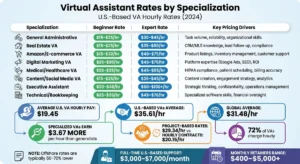
US-based junior VAs (1 to 2 years of experience) run $15 to $25 per hour. Mid-level hires hit $30 to $50. Specialized professionals, like tech-savvy or marketing VAs, clear $50 to $100+.
International freelancers drop those numbers significantly. Rates from the Philippines and India often fall between $5 and $20 per hour.
Agencies charge more, usually $40 to $150 per hour. They bundle vetting, QA, coverage, and a contract you can walk away from without drama. If you cannot afford to waste a week on a bad hire, that premium often pays for itself.
Many agencies and established freelancers prefer monthly retainers over open-ended hourly work. This gives both sides predictability.
Typical retainer packages look like this:
| Package | Hours Included | Monthly Price (US Freelance) |
|---|---|---|
| Starter | 10 hours | $250 to $500 |
| Standard | 20 hours | $500 to $1,000 |
| Pro | 40 hours | $1,000 to $2,000 |
| Executive | 60+ hours | $2,000 to $4,000+ |
Retainers often come with reduced rates per hour, but they lock you into a minimum. If you do not use the hours, you still pay. Be honest about your volume before committing.
Off-the-shelf AI tools are cheap because they are shared infrastructure. Custom-built AIVAs, trained on your business, cost far more to build and run.
A consumer AI subscription runs $20 to $30 per month. A business plan with team seats and stronger privacy guarantees runs $25 to $60 per seat.
Custom AI agent development starts around $2,000 to $10,000 for a small project, plus monthly hosting and API costs. That only makes sense once the AI is replacing a real, recurring human task at scale.
For most readers right now, a $20 subscription plus a part-time human covers 90% of what you actually need.
Cost efficiency depends on where you sit on the growth curve. A model that makes sense for a solo founder can burn cash for a 15-person team.

If you operate as one person, you almost never need a full-time VA. The work is too variable.
Start with an AI subscription for repetitive work. Summaries, drafts, calendar prompts, and simple lists are all things you can delegate to software today.
When the task list gets overwhelming, add a part-time freelance VA for 5 to 10 hours a week. That is $150 to $500 per month. This is the single most cost-effective setup for solo founders as of 2026.
Once you cross 10 hours a week of VA work, hourly billing starts to hurt. A 20-hour retainer at $35 an hour is $700 per month. The same hours billed open-ended at $45 an hour run $900.
Agencies also solve two problems freelancers cannot. You get a backup person if someone gets sick, and someone who actually manages the relationship. For a growing team, that insurance is worth the premium.
Executive assistants do different work than general VAs. They handle travel, board prep, confidential correspondence, and priority triage for busy founders and C-suite leaders.
Specialized EAs charge $50 to $100+ per hour. If your time is worth $300+ per hour, the math almost always works. A $4,000 monthly retainer buys back 40 hours of executive focus.
That is rarely a bad trade.
The sticker rate is only half the story. Onboarding, tools, platform fees, and mistakes quietly add up.

Every VA, new or old, needs orientation. Set expectations, define access, share your tools, and document your systems.
Plan on 4 to 8 hours of unpaid onboarding time, depending on role complexity. If you are hiring someone for a specific function, like a medical VA, that ramps closer to 20 hours of paid training.
Tool overhead stacks too. A single VA often touches 3 to 6 paid apps per month, like calendars, task managers, CRM, and design tools. Budget $30 to $120 per month in extra software cost.
Free VA marketplaces charge a cut. Typical rates run 10% to 20% of every transaction.
At $30 per hour, that is $3 to $6 back to the platform. A 20-hour retainer at $35 per hour becomes $42 per hour after fees. Factor the cut into your true cost.
Every bad hire eats time and trust. Mistakes on financial data, emails to clients, or social media posts are real costs.
Turnover is the bigger one. Replacing a VA mid-project costs another 4 to 8 hours of onboarding and a learning curve that hits your business while they ramp.
Two things cut this risk. A paid trial period with a clear task map, and an offboarding checklist that includes password rotation and access revocation. Both cost money.
Both save more than they cost.
This is where most pricing conversations go wrong. Misclassifying a worker can undo every dollar you saved on a "cheaper" VA.
The US Internal Revenue Service tests contractor status on 20 factors, including control over work, schedule, and financial investment.
If you set exact hours, provide equipment, or dictate workflow, the worker is likely an employee. If they own their tools, set their schedule, and serve multiple clients, they are likely an independent contractor.
Misclassification invites IRS audits, back taxes, and penalties. Those penalties exceed the savings of any VA arrangement.
Any VA touching client info, financials, or health data needs an NDA before work starts. If you do not have one, get one.
For sensitive work, enforce multi-factor authentication on every shared account. Follow the guidance from NIST cybersecurity frameworks to keep access logs and password controls in place.
Use a project manager tool for accountability, so you can track every hour and see exactly what was done.
If your VA makes a costly mistake, you usually carry the liability. Ask whether they carry errors-and-omissions insurance. Many agencies do.
Most freelancers do not.
When they leave, pull access immediately. Rotate passwords, transfer shared account ownership, and revoke every tool login tied to their name. It sounds dramatic, but it is the cheapest insurance you will ever buy.
Every bad hire traces back to the same gap: you did not test the person before the money moved. Fixing that takes three moves.
A paid trial beats an unpaid one every time. When someone is being paid, they show up with the same energy they bring to your real work.
Standard trial length is 2 to 4 hours. Define one deliverable with a clear deadline. Give access to only the tools and files needed for that task.
Review the output against three criteria: turnaround time, task accuracy, and tone of communication. If two of the three are weak, walk away before you commit.
Watch for a few tells that show up across hundreds of failed hires.
| Red Flag | What It Signals |
|---|---|
| No samples of past work | Likely overstates experience |
| Vague answers about tools | Unfamiliar with real workflows |
| Pushy hourly discount offers | Cutting corners on quality |
| No written process | Reactive, not systematic |
| Avoids asking about your business | Not invested in long-term fit |
A strong candidate will ask pointed questions about your tools, your clients, and your VA skills baseline. That is the sign of someone who has done this before.
Three questions separate professional VAs from part-timers who happen to be online.
Ask how they handle unexpected tasks mid-day. Ask what happens if they miss a deadline. Ask how they document their work so you can hand off cleanly if they leave.
Written answers reveal maturity. Vague or reluctant answers mean you will spend more time managing than they will spend working. A free resource list for tooling will help you build the process side before you hire.
As of 2026, the US average sits between $20 and $35 per hour for general VAs. Senior or specialized VAs, like executive or tech-savvy assistants, run $50 to $100 per hour. International freelancers often charge between $5 and $20 per hour.
For drafting, summarizing, and routine scheduling, AI is far cheaper. A $20 to $30 monthly subscription replaces hours of work. Human VAs still win on judgment, nuanced communication, and hands-on client work that AI cannot handle reliably today.
Yes. Agencies typically run 50% to 100% higher than individual freelancers for the same task. The premium covers recruiting, vetting, QA, and coverage.
It is worth it when downtime costs more than the markup.
Start part-time. If you are consistently booking more than 25 hours a week for 4 to 6 weeks straight, full-time makes sense. Under that threshold, a retainer or freelance arrangement saves you money and keeps flexibility.
Not always. Many charge regular hourly rates for onboarding. Agencies often bundle a setup fee, typically $100 to $500, that covers tools, workflow documentation, and initial task mapping.
Ask before you sign anything.
Write a specific task list before hiring. Match hours to real workload. Run a 2 to 4 hour paid trial with a defined deliverable.
Skip vague hourly billing if you can lock into a retainer once volume is predictable.
You asked one question. Here is the direct answer, mapped to where you actually are.
| Your Situation | Best Model | Realistic Monthly Cost |
|---|---|---|
| One-time tasks, under 4 hours a week | AI Assistant + occasional freelance | $30 to $300 |
| Steady admin, 5 to 10 hours a week | Part-time freelance VA | $250 to $600 |
| Heavy workload, 20 to 40 hours a week | Agency retainer or mid-level freelancer | $800 to $2,000 |
| Executive or high-stakes work | Senior EA or specialized agency | $2,000 to $5,000+ |
| Full-time back-office operations | W-2 full-time VA | $3,000 to $6,000 |
Two things beat any rate number you find online. Match the model to your actual workload. Price in the hidden costs before you sign.
If you are unsure where you fall, start smaller than you think you need. You can always scale up with a paid trial. Scaling down from a bad commitment is where most readers end up paying double for the same work.
Understand what they can actually handle, from core VA tasks to role-specific work like a real estate VA setup, before you set a budget. The mismatch between task complexity and rate is the single most common reason people end up overpaying or under-hiring.
If your business runs on specific workflows, look at which tasks to outsource first. That clarifies the actual hours and justifies the number you pay for them.

















You’re staring at a Calendly page that’s filling with booking requests faster than you can reply. A virtual assistant for Calendly can take that load, but only…
You’re drowning in meeting requests and your calendar looks like a war zone. Virtual assistant Calendly management is the fix that lets a trusted helper handle…
You’ve got too many meetings and not enough hours. A virtual assistant for Outlook Calendar can fix that, but only if you pick the right type. We’ll walk…