⚠️ Disclosure: This post contains affiliate links. We may earn a commission at no extra cost to you.
⚠️ Disclosure: This post contains affiliate links. We may earn a commission at no extra cost to you.


If you're asking how much does a virtual assistant cost per hour, the answer splits in two. Human virtual assistants (VAs) charge by the hour. AI assistants charge a flat monthly subscription that has nothing to do with time.
Most guides blur the two together, and that's where people end up surprised by the bill.
In aggregate rate surveys from 2026, a typical human VA lands between $15 and $45 per hour. AI tools like ChatGPT and Notion AI run $20 to $300 per month, whether you use them once or a thousand times. That's the whole story in one line, and it changes everything you do next.
A human virtual assistant costs $15 to $45 per hour as of 2026. AI assistants don't bill per hour. They charge flat monthly subscriptions.
A freelance human VA starts near $15 per hour. A specialized agency VA can reach $60 or more. AI tools like ChatGPT run $20 per month.
AI agents like OpenAI Advanced Run run up to $300 per month. Pick the model that matches your workload.
Image source: Web (Bing) / mikaranja.com (Web image (fair-use with source credit))

Image source: Bing (Web (fair-use with source credit))
There are two ways to hire a human VA. You can grab an individual from a freelance platform. You can also rent from a specialized agency.
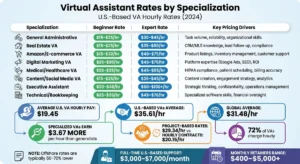
Freelance marketplaces like Upwork, Fiverr, and Toptal list thousands of individual VAs. You set the scope, negotiate the rate, and pay hourly or per task. Rates in 2026 typically fall in these bands:
The BLS reports an average hourly wage around $19 for administrative roles, which is a fair baseline for entry-level admin VA work. Freelance rates vary because of time zone overlap, specialization, and volume commitment. A full-time arrangement at 40 hours a week usually comes with a discount.
A 5-hour per week engagement usually costs more per hour.
Freelancers are cheap for the skills they deliver, but you manage the reliability yourself. That means onboarding time, occasional gaps, and direct conversation. See our Virtual Assistant Pros And Cons guide for a full breakdown of the trade-offs before you commit.
A VA agency is a full company that supplies you a vetted assistant. They charge between $25 and $60+ per hour. The premium covers vetting, backup coverage, project management, and quality review.
If your VA calls in sick, the agency swaps someone in the same day. You lose the low-cost flexibility of a freelancer, but you gain accountability.
Agencies work well for executives and small teams who can't absorb the overhead of direct hiring. Solo creators and one-off projects usually don't need that premium. Most VA roles follow the pattern covered in our What Can a Virtual Assistant Do resource.
Image source: Web (Bing) / sendbird.com (Web image (fair-use with source credit))
AI assistants don't bill by the hour. They bill by access tier or token use.
Most mainstream AI assistants operate on monthly subscriptions. ChatGPT Plus runs $20 per month. ChatGPT Team and Enterprise tiers land between $25 and $30 per seat.
Notion AI is bundled into workspace plans that run $10 to $18 per user per month. Microsoft Copilot adds $30 per user per month on top of an Office 365 plan. Whatever you put on the card, you get access to the same model the same way, whether you use it once or once a day.
That's a completely different billing structure from an hourly human VA. You can't divide the monthly fee by a fixed hour count, because the workload changes weekly.
Some AI assistants also bill per API call or per completed task. OpenAI's Advanced Run agents, launched at $200 per month plus usage, charge per action taken. Anthropic Claude offers per-token pricing via API, typically $3 to $15 per million input tokens depending on the model.
If you ran an AI agent for 40 hours a week at a heavy usage level, you might spend $200 to $500 per month. Dividing that by 40 gives you an effective $5 to $12 per hour. That math works only if you run it constantly.
Idle time doesn't scale the price down.
For context, the human work an AI replaces differs sharply from what a trained virtual executive assistant handles. AI drafts and summarizes well. It can't call your landlord or read the room in a client meeting.
Image source: Bing (Web (fair-use with source credit))
The most useful comparison isn't hourly rate alone. It's total cost of ownership over a month.
| Option | Typical Hourly | Setup Fee | Monthly Commitment | Best For | Management Burden |
|---|---|---|---|---|---|
| Freelance Human VA | $15 to $45 | $0 to $200 | 10 to 40 hours | Judgment tasks, client-facing work | Medium to high |
| AI Subscription | N/A (flat) | $0 to $300 | $20 to $300 | Drafting, research, summarization | Low after setup |
| VA Agency | $25 to $60+ | $200 to $2,000 | 20 to 40 hours | Delegated workflows, backups | Low |
| Full-time Hire | $50 to $90+ | $2,000 to $5,000 | Salary plus benefits | 40 hours of core coverage | High |
The BLS reports that wages at bls.gov for office and administrative specialists run about $19 per hour on average. That's your floor for a competent human admin VA.
Here's how the math shakes out at 20 hours per month:
AI wins on raw cost. A human wins on judgment. An agency wins on reliability.
The right choice depends on what the task actually is.
Cost per hour tells you almost nothing without the task behind it. Let's map them.
A human VA earns their rate when a task involves judgment, relationships, or context. Executive scheduling, inbox triage, client follow-ups, vendor calls, and sensitive decision-making all fit here. A virtual medical assistant handling insurance verification or patient scheduling is a perfect example.
These roles can't be handed to an AI safely.
AI wins when the workload is repetitive, text-based, and volume-driven. Drafting emails, summarizing documents, generating SEO briefs, and parsing invoices all fit here. A solopreneur drafting 200 emails a month can get that done for $20, and the AI never takes a sick day.
If your workload is small and steady, a freelance VA is usually the sweet spot. If it's repetitive at scale, AI. If you need a managed relationship, an agency.
The full virtual assistant tasks list breaks down which jobs fit which category.
For real estate agents, a real estate virtual assistant typically lands in the $25 to $50 per hour freelance band and handles listing coordination, buyer outreach, and showing management.
The headline rate is rarely the full expense. Setup fees are a common shock. Agencies charge $200 to $2,000 for workflow mapping and tool integration.
Freelancers often skip this, but you still spend hours onboarding them yourself. That time has a real cost if you value your labor.
Software subscriptions add a hidden layer. If your VA works in your CRM, Slack, and project management tool, you need a seat for them. A single SaaS platform can cost $10 to $50 per user per month.
Multiply that by three tools and the overhead jumps quickly. Check if your current plan allows guest access or if you need a full license.
Training and revision loops eat budget too. A new VA makes mistakes. Correcting them takes your time.
If the task was supposed to take one hour, you might spend three. This is where tracking VA time honestly becomes critical. Without clear logs, you pay for inefficiency without noticing it.
Finally, offboarding costs matter. When you fire a VA or switch agencies, you lose institutional knowledge. You have to retrain the replacement.
For specialized roles, like a virtual medical assistant, this retraining period can cost 10 to 20 hours of management.
Match the tool to the task, not the reverse. If the work is repetitive and text-based, start with AI. Drafting emails, summarizing notes, and basic research are perfect for subscription models.
You get infinite volume for a flat fee.
If the work requires judgment, relationships, or client-facing communication, hire a human. A virtual executive assistant manages calendars and handles sensitive calls. AI cannot navigate a difficult client conversation.
It lacks empathy and context.
For high-stakes or specialized industries, verify compliance before you spend. If you work in healthcare or finance, you need strict data privacy. Check if your provider signs NDAs and adheres to standards.
You can find guidance on outsourcing tasks safely to ensure you aren't leaking sensitive data.
If you are a solopreneur with inconsistent cash flow, a hybrid model often wins. Use AI for the bulk of drafting. Pay a freelance VA only for the 5 hours a week where human judgment is required.
This keeps your fixed costs low while preserving quality.
If you need 24/7 coverage across time zones, a single human VA is not enough. Consider a global agency that rotates shifts. For niche expertise, look for certified specialists.
Review virtual assistant skills needed to identify the specific competencies you actually require before you commit to a hire.
Usually, yes. A full-time employee includes benefits, payroll taxes, and overhead. That raises the true cost per hour significantly.
A freelance VA or agency charge is often lower because you avoid those extras. However, you get less control and consistency than with an in-house hire.
You can try, but leverage matters. If you commit to 40 hours a week, you can negotiate a discount. Spot work or 5-hour engagements usually carry a premium.
Agencies rarely negotiate rates. They focus on retention instead. Freelancers on platforms are more flexible with volume commitments.
Generally, yes. VAs in the Philippines or Eastern Europe charge $5 to $20 per hour. US-based VAs charge $30 to $80.
The tradeoff is time zone overlap. You may need to adjust your working hours to collaborate effectively. This flexibility is a major benefit of remote support.
Most have flat pricing, but usage limits exist. If you exceed the token limit, you pay for overage. Complex agents that run many tasks can spike your bill.
Always check the API documentation for per-task pricing models before scaling your workflow to avoid surprises.
Most use platforms like PayPal, Wise, or direct bank transfer. Agencies often bill monthly via credit card or ACH. Freelancers on platforms use the site's escrow system.
Set up a dedicated account for these payments to keep your bookkeeping clean and simple.















Virtual assistant monthly rates are confusing because they vary wildly based on four distinct pricing models. Offshore generalists start around $600 per month,…

The honest answer is: it depends on who you hire, where they are based, and how you structure the engagement. Our analysis of hiring data shows most small…

You’re probably exhausted by the conflicting numbers you see online. Virtual assistant pricing varies wildly because costs depend on skill sets, location, and…