⚠️ Disclosure: This post contains affiliate links. We may earn a commission at no extra cost to you.
⚠️ Disclosure: This post contains affiliate links. We may earn a commission at no extra cost to you.



If you're searching how much does a virtual assistant make, you probably want a real number, not a range that spans from $5 to $80 an hour. The honest answer is that VA pay in 2026 is all over the map, and it depends on niche, location, and experience more than anything else.
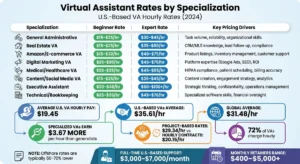
Entry-level generalist VAs can start around $10 to $20 per hour, while specialized seniors charge $40 to $80 or more. That spread is real. So the useful answer isn't a single number, it's understanding what drives the rate you see.
That's where we'll start.
How much does a virtual assistant make varies widely. Generalists earn $10 to $20 per hour. Experienced specialists charge $30 to $80.
Senior niche VAs can exceed $100. Offshore rates run far lower, often under $15. Retainer clients pay for ongoing monthly support.
Once you've seen the range, the real question is what moves it. Four variables do most of the heavy lifting: niche, experience, geography, and how you structure the engagement. Miss one and you'll undershoot.
Hit all four and the rate climbs fast.
The easiest way to underpay yourself is to sell yourself as a generalist. "I do everything" reads to clients like "I don't charge much." Specialized VAs, who handle one domain end to end, command very different rates.
The U.S. Bureau of Labor Statistics tracks the median administrative wage around $23 per hour, which lines up closely with generalist VA earnings. Specialist VAs working independently clear well past that floor.
Years in the field matter, but only when paired with the right niche. A fifth-year generalist often makes less than a two-year tech specialist.
The rate doesn't jump the day you graduate out of year two. It climbs when you can point to concrete deliverables: a pipeline you built, a CRM you fixed, a launch you ran. Clients pay for outcomes, not tenure.
Pair your hours with strong time tracking habits and the value becomes easier to prove.

Where you sit on the map moves the number by more than any other single factor. The same list of tasks, handled by an onshore VA in Seattle versus an offshore VA in Manila, can produce rates that differ by 4 to 6x.
The gap isn't about skill. It's about local cost of living and the purchasing power of the client. Onshore VAs get paid like U.S. workers.
Offshore VAs get paid for the local economy they live in, which is why a large share of remote support work has shifted outside North America over the past decade.

How you get paid matters as much as how much. The same VA, doing the same work, will earn meaningfully more on a retainer than on hourly.
Retainer VAs bill a fixed number of hours each month whether they use them all or not. That structure turns variable work into steady monthly income and shifts the dynamic from "did you bill me too much?" to "what can we add next?" It's the single biggest lever for moving from gig pay to professional pay.
Different VA roles don't just sound different on paper. They pay differently, scale differently, and hit different ceilings. Here's how the common types actually compare.
| VA Type | Typical Hourly | Best For | Growth Ceiling |
|---|---|---|---|
| General Admin | $10 to $20 | Inboxes, scheduling, data entry | Low, competes on price |
| Executive Assistant | $30 to $75 | Senior leadership support | High, grows with the exec |
| Real Estate VA | $15 to $35 | Listings, CRM, showings | Mid, scales with agent team |
| Marketing VA | $20 to $45 | Content, ads, social | High, tied to revenue output |
| Bookkeeping VA | $25 to $50 | QuickBooks, invoicing, reconciliation | High, regulated niche |
| Tech/Dev Support VA | $30 to $80+ | Code, automation, integrations | Very high, specialist premium |
| Medical/Admin Support | $20 to $45 | Scheduling, records, compliance | Mid, gated by credentials |
The pattern holds: the more regulated the niche, the higher the pay. The more tied to client revenue, the easier to justify a premium. General admin support competes on cost, so that's where rates live at the bottom of the table.
If you're trying to build a portfolio, look at what tasks are actually outsourceable to spot where the demand is. The roles with steady pull and limited supply are the ones you want to grow into.
Most VAs start on hourly, but the model you're paying to get off of is the wrong one to stay on. Let's break down each option honestly.
Hourly rates. You charge a set amount per billable hour. It's transparent and easy to explain. It also caps your earning potential at the number of hours in a week.
As your load grows, the income ceiling does too, and clients start watching the clock.
Monthly retainers. You commit to a set number of hours or a defined scope each month, and the client pays in advance. Predictable cash flow. More leverage to negotiate scope.
Downside: you have to keep the calendar full, or the income disappears.
Project-based pricing. You quote a fixed number for a defined job with a clear end. Works well for things like building a lead-magnet funnel or setting up a CRM. The risk is estimating wrong, so most experienced VAs pad the scope buffer.
Here's how they stack up side by side.
| Model | Predictability | Client Comfort | VA Earning Ceiling | Best When |
|---|---|---|---|---|
| Hourly | Low | High | Low to mid | Starting out |
| Monthly Retainer | High | Mid to high | High | Steady relationships |
| Project-Based | Mid | Mid | Highest per hour | Defined deliverables |
The right model depends on where you are. New to the space, take hourly. Have repeat clients?
Move them onto retainers. Landing one-off work? Quote the project, not the hours.
The gap between a $12/hour VA and a $60/hour VA isn't usually hours worked. It's how they position, what they deliver, and how they're booked. The higher earner isn't necessarily faster.
They just do things differently.
Here's what the pattern looks like in practice:
The path from $15 to $60 per hour isn't mystical. It's specialization, proof, and positioning. If you're still stuck at the bottom of the range, the fix is usually one of those three, not more hours or more clients.
The VAs stuck at the bottom of the range usually didn't get there by accident. A few repeated mistakes do almost all the damage.
Selling without a niche. A generalist pitch invites generalist pricing. The moment you say "I can handle admin, social, bookkeeping," you hand the buyer permission to compare you against the lowest bidder.
Sticking to hourly for too long. Hourly caps your income at whatever you can fit into the week. It also trains clients to watch the clock instead of the outcome.
Not tracking deliverables. If you can't show the number you moved, the launch you shipped, or the hours you saved, you'll always pitch at the task level. Clients pay for outcomes, not to-do lists.
Skipping rate increases. Rates should climb every 6 to 12 months, not when you "feel ready." A fixed percentage increase, tied to a review date in the contract, keeps you from getting frozen in year-one pay.
Vague contracts. Scope creep is the silent killer. Without a written list of recurring tasks and defined boundaries, the same 20 hours a week ends up absorbing 40 hours of work.

If you're the VA here, not the buyer, the pricing question is real. Start with the market floor for your niche, not your cost of living.
Rate isn't a favor you negotiate. It's the price of the value you hand over.
Most VAs earn $10 to $20 per hour as beginners. Specialists reach $30 to $50, while senior niche experts can exceed $80 per hour. Offshore VAs often work for $5 to $15 per hour, depending on where they're based and how deep their niche goes.
They do one niche, they sell outcomes instead of tasks, and they move to retainers fast. A specialist who runs a full real estate pipeline charges more than a generalist clearing inboxes, because the outcome is different.
Yes, often 60 to 80 percent less. Offshore VAs typically earn $5 to $15 per hour. Onshore VAs in the US or UK sit at $25 to $75 per hour.
Time zones and support quality trade off against the savings.
Tech, bookkeeping, and legal VAs top the range. They earn $30 to $80+ per hour. Medical support and marketing sit in the middle at $20 to $45.
General admin support stays near the floor at $10 to $20.
Yes. Senior specialists on retainer often do. Multiply $50 per hour by 25 billable hours a week and you clear $65,000 a year on one focused client.
Two or three steady accounts cross the $100,000 mark easily.





















A virtual assistant can handle your inbox, but “manage” is a spectrum. Sorting, drafting, and sending carry different risks. Each task needs specific…

You’ve probably heard the pitch: AI voice assistants can now manage your whole calendar. The promise is a fraction of the reality. Yes, some assistants can…

The short answer is yes, but the capability varies wildly by platform. Some assistants can dial a number instantly; others can only trigger a callback. If you…