⚠️ Disclosure: This post contains affiliate links. We may earn a commission at no extra cost to you.
⚠️ Disclosure: This post contains affiliate links. We may earn a commission at no extra cost to you.

You're staring at a job post or a DM from a freelancer and you've landed on the same question a hundred business owners do: how much should I pay a virtual assistant and not get burned? The good news is there's a real answer here. The bad news is the range is wide enough that guessing wrong costs you either money or talent.
Per Bureau of Labor Statistics data, U.S. administrative clerks earn about $19 per hour and executive secretaries around $23 per hour. Offshore VA rates run $3 to $25 per hour depending on skill, specialization, and time zone overlap. Let's break down how to pick a number that actually works for your situation.
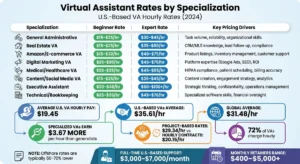
There is no single right number to how much should I pay a virtual assistant. In 2026, expect to pay roughly $3 to $8 per hour for entry offshore VA work. Skilled offshore VAs earn $8 to $25 per hour.
Near-shore and domestic VAs typically charge $20 to $45 per hour. Executive or specialized roles can run $35 to $60 per hour.
The answer to how much should I pay a virtual assistant depends on three levers: skill, location, and scope. Skip any one and you'll either overpay or attract the wrong talent.
The most useful way to anchor your number is U.S. Department of Labor benchmark wages for the closest in-house role. Administrative secretaries average around $23 per hour, executive secretaries around $31, and receptionists around $15.
Those are full employee benchmarks with benefits baked in, so VA rates tend to sit below them but not by much for onshore work.
Here's a realistic pay table as of 2026:
| VA Type | Hourly Range | Typical Weekly Commitment |
|---|---|---|
| Entry-level offshore (Philippines, South Asia) | $3 to $8 | 5 to 20 hours |
| Skilled offshore (Latin America, Eastern Europe, Caribbean) | $8 to $25 | 10 to 40 hours |
| Near-shore / domestic (US, UK, Canada, AU) | $20 to $45 | 10 to 40 hours |
| Executive virtual assistant, domestic | $35 to $60+ | 20 to 50 hours |
| Industry specialist (medical, real estate, SaaS ops) | $25 to $55 | 15 to 40 hours |
What moves the price up? Virtual assistant skills needed that aren't generic. CRM management, calendar triage for a busy executive, bilingual customer support, WordPress builds, or a firm grip on Notion and Airtable all push rates toward the top of their band.
What holds the price down is task volume that's simple and repeatable. Answering tickets, entering data, transcribing calls, and scheduling can all sit in the entry range without being cut-rate.
Don't use nationality as your pricing ceiling. A skilled Filipino VA with five years of CRM work should outearn a domestic generalist just starting out. Pay for the outcome, not the flag.
How much should I pay a virtual assistant depends on which billing model you pick. There are really three. Hourly pricing pays per hour logged.
Retainer pricing pays a fixed weekly or monthly rate for agreed hours. Trial pricing runs a paid test task before you commit to anything long.
If your workload is unpredictable, go hourly. You only pay for real work, and time tracking tools like Toggl, Clockify, or a VA time tracking system keep it fair on both sides. If you need the same person doing a steady 20 or 30 hours every week, go retainer.
Retainer rates are typically 30 to 50 percent cheaper per hour than hourly, because reliability has value.

| Model | Best For | Typical Cost | Watch Out For |
|---|---|---|---|
| Hourly | Ad-hoc or project-based | $5 to $60+ per hour | Requires honest time tracking |
| Monthly retainer | Steady weekly work | $400 to $4,000+ per month | Higher commitment, harder to exit |
| Trial task | Testing fit before hiring | $50 to $300 | Doesn't reveal long-term quality alone |
Trial days are underrated. Pay for a half day or a full task on a trial basis before you commit to a retainer. That's your safety net, and it catches communication style issues before you're stuck paying a monthly fee for weeks.
Most seasoned VA agencies use a trial period because they know the first interaction says a lot about long-term fit.
The rule of thumb? Run a trial first, then choose hourly or retainer based on how steady the work looks after two weeks of real collaboration.
Sometimes you need to pay more. Sometimes you don't. The trick is spotting which side of the line you're on.
Pay a premium when the work is sensitive, client-facing, or highly specialized. If your VA will handle client PII, financial records, patient information, or executive correspondence, the price floor goes up. If they're working solo on customer emails, public drafts, or social posts that carry your brand, the price floor goes up.
If they need industry tools like HubSpot, Salesforce, WordPress, Notion, or QuickBooks, the price floor goes up. What is a virtual executive assistant is a great reference point. Most executive-level coverage runs at least $35 per hour.

| Signal | Rate Direction |
|---|---|
| Handling sensitive or regulated data | Premium |
| Client-facing communication | Premium |
| Specialized tools or industry knowledge | Premium |
| Executive calendar and inbox management | Premium |
| Basic data entry, inbox triage, scheduling | Base rate |
| Highly repeatable, low-judgment tasks | Lower band |
The premium usually runs $2 to $8 per hour for domestic and near-shore work, or $8 to $15 per hour for offshore specialists in high-skill roles.
You can pay less when the task list is genuinely routine. Basic inbox triage, straightforward scheduling, simple data entry, meeting notes, and repetitive follow-ups all live in the entry band. Start with an offshore generalist, run a trial, and only move up when the work actually demands it.
Pay goes wrong when scope is fuzzy. Fix that first and pricing becomes a much simpler conversation.
Here's a tight five-step process you can run this week:
| Phase | Key Action | Timeframe |
|---|---|---|
| 1 | Define recurring tasks and deliverables | Before posting |
| 2 | Set weekly hours and response SLA | Before posting |
| 3 | Run a paid trial task | Day 1 to 3 |
| 4 | Document onboarding and SOPs | Week 1 |
| 5 | Monthly performance review | Ongoing |
Scope is the most underrated lever in VA pricing. If you want to save money, tighten the scope first, not the hourly rate. That's how you get good work without a huge bill.
You can also browse free VA tools and resources to keep the overhead low while you nail the process.
Also, remember that what a virtual assistant can do is broader than most founders realize. Medical VAs, real estate VAs, and executive VAs each have their own task sets. Pick your starting point based on what you can actually supervise, not what sounds impressive on a job post.
Most bad VA hires start with a pricing mistake, not a hiring mistake. Here are the ones we see most often.
Paying below a real living rate. In the Philippines, for example, $3 to $5 an hour is common but pushes people toward short tenure and side work. If you can pay $6 to $8, you'll keep better talent longer and see fewer replacements. That's not charity.
It's retention math.
Not setting an NDA and data boundary. If your VA touches client data, customer PII, or financial info, use a signed NDA before they touch anything sensitive. In the U.S., contractor vs. employee classification matters too. Misclassifying can trigger IRS penalties under IRC 3509 rules, and in the UK, HMRC runs IR35 checks for similar contractor-employee lines.
When in doubt, a virtual assistant pros and cons breakdown will help you decide whether contract work even fits your situation.
Letting scope creep quietly. A "small extra thing here, a little task there" adds up fast. At some point your entry-level VA is doing executive-level work at entry-level pay. Either adjust the scope down or move the rate up.
Ignoring it burns trust and usually costs you the VA.
Paying too much for the wrong person. A $40-an-hour offshore specialist doesn't exist for general admin work. Overpaying attracts candidates hoping to underdeliver and get away with it. Match the market for the specific work.
Skipping the trial. Every failed long-term VA relationship we've seen started with a trial that either never happened or was too short. A paid trial is cheap insurance. Run it.
| Mistake | Fix |
|---|---|
| Rate below living wage | Pay $1 to $3 more and expect higher retention |
| No NDA for sensitive data | Sign before access is granted |
| Scope creep ignored | Monthly review and scope document |
| Overpaying for the wrong role | Match market rate to task, not persona |
| No trial task | Always pay for a 1 to 2 day trial first |
You can also look at what tasks to outsource to a VA before deciding who to hire and at what price. If you're considering specialized hires, what a real estate virtual assistant does or what a virtual medical assistant does gives you a concrete task list to price against. And if the whole VA question is still weighing on you, our breakdown of benefits of hiring a virtual assistant lays out the upside clearly before you commit to any rate.
Offshore entry-level VAs run $3 to $8 per hour. Skilled offshore VAs earn $8 to $25 per hour. Domestic and near-shore VAs typically charge $20 to $45 per hour.
Executive or highly specialized roles can run $35 to $60 per hour.
Hourly fits unpredictable or project-based work. Retainer fits steady weekly loads of 15 to 40 hours. Retainers usually cost 30 to 50 percent less per hour than hourly, but you lose flexibility to scale down quickly.
Usually yes, but not automatically. AI use is a productivity multiplier only when the output quality holds up. Trial a specific task with AI in the loop and price on the outcome, not the tool.
Most trials run $50 to $300 depending on length and complexity. A two-hour discovery task runs $50 to $150. A full-day deep-dive task runs $150 to $300.
Never run a free trial. It signals that the work isn't real.
Raise the rate when the role has grown. New tools, new clients, higher judgment, more responsibility, or executive access all justify a bump. Review scope every month and adjust every three to six months as the role matures.




















The honest answer is: it depends on who you hire, where they are based, and how you structure the engagement. Our analysis of hiring data shows most small…

You’re probably exhausted by the conflicting numbers you see online. Virtual assistant pricing varies wildly because costs depend on skill sets, location, and…
Confusing rate sheets and hidden overheads often make virtual assistant service pricing feel like a guessing game. You might find a freelancer at $15/hour and…