⚠️ Disclosure: This post contains affiliate links. We may earn a commission at no extra cost to you.
⚠️ Disclosure: This post contains affiliate links. We may earn a commission at no extra cost to you.


Hiring help is expensive and slow. Getting virtual assistant package pricing wrong is worse. The right price hinges on how many hours you truly need, what skill level the role demands, and whether you want hourly, retainer, or fixed-scope support.
US assistant pay data from the Bureau of Labor Statistics shows general administrative assistants averaging a bit over $24 an hour. Layer in employer-side taxes and benefits and the real cost climbs. Here's how to price VA support correctly as of 2026.
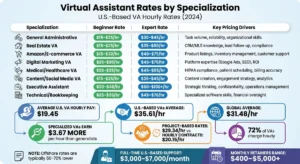
Virtual assistant package pricing ranges from $200 to $4000+ per month. General admin packages sit at the low end. Specialist or executive packages sit much higher.
The hourly rate averages $20 to $50 for US and offshore freelancers. Fixed-scope packages usually land between $750 and $2500 monthly. Always price the hours first, then the skill level, then the structure.
Flat monthly fees sound clean. They rarely fit the actual work. One founder books 40 calendar events a week.
Another schedules two calls. Paying both the same misses the mark.
Flat pricing also hides skill gaps. A general admin who runs calendars costs less than a marketing specialist who builds campaign briefs. Pricing only the monthly fee ignores the hours and expertise underneath.
If you skip the workload assessment, you either overpay for unused capacity or underpay and lose your VA in weeks. The benefits of hiring a VA only show up when scope matches the price.
Before you quote a number, log every admin task for one full week. Capture hours, frequency, and effort. This gives you a real baseline, not a guess.

Break tasks into three buckets:
Track time with tools that fit small teams. Our review of virtual assistant time tracking tools highlights simple options like Toggl and Clockify. Aim for 5 to 15 hours of accurate logging before pricing.
| Task Type | Weekly Hours | Skill Level | Pricing Impact |
|---|---|---|---|
| Calendar and inbox | 3 to 8 | General admin | Baseline rate |
| Social media drafting | 4 to 10 | Light specialist | 1.3 to 1.5x |
| CRM and reporting | 5 to 12 | Specialist | 1.5 to 2x |
| Executive support | 10 to 25 | High-touch specialist | 2x and up |
Once you know the hours, stack support into tiers. Each tier adds capability, complexity, and cost.
A real estate virtual assistant listing and lead package looks different from a coaching inbox package. Industry specialization raises the floor.
Three pricing models dominate the VA market. Pick the one that matches your workload pattern.

Retainers usually run 15 to 25 percent cheaper per hour than spot hourly work. Outsource the right tasks and the savings compound fast.
Hourly wins for one-offs. Retainers win for steady weekly work. Fixed-scope wins for clear deliverables with variable effort.
Match the model to the work, not the other way around.
Pricing mistakes usually stem from ignoring scope creep. If you bill hourly but let the VA drift into undefined tasks, your margin disappears. Always use a written virtual assistant tasks list to lock boundaries.
Underpricing is just as risky. If you charge $15 an hour for marketing support, you attract clients who expect CEO-level strategy. The result is burnout and churn.
Set rates that reflect the virtual assistant skills needed for the specific output.
Many owners forget the administrative overhead. You are not just paying for typing. You are paying for CRM maintenance, email triage, and report formatting.
Factor in 10 to 15 percent of the total bill for coordination and management time.
Use these benchmarks to sanity-check your package costs. They help you spot when a quote feels off.

| Structure | Best For | Typical Cost Range |
|---|---|---|
| Hourly | One-off projects, undefined scope | $20 to $50 per hour |
| Monthly Retainer | Recurring admin, steady workflow | $500 to $2,000 per month |
| Fixed-Price Package | Defined deliverables, clear outcomes | $750 to $2,500 per month |
If your workload is steady, a retainer saves money. If you need results for a specific campaign, pay for the package. Hourly billing works best when you cannot predict the workload.
Compare these options against virtual assistant pros and cons to find your fit.
Treat your VA agreement like a legal contract. Independent contractor rules vary by state and country. Misclassifying a worker as a contractor can lead to penalties.
Consult the U.S. Small Business Administration for guidance on local regulations.
Always sign a non-disclosure agreement. Your VA will access client data, financials, and passwords. Define data privacy rules in your contract.
Use secure file transfer tools to limit risk. Free virtual assistant resources and tools can help you set up secure access without buying expensive software.
Most small businesses spend between $500 and $2,000 monthly. This assumes 20 to 40 hours of general admin work. Specialized marketing or executive support costs more.
Usually, it is cheaper. You avoid payroll taxes, benefits, and office space. The BLS data shows admin costs rise significantly with employment benefits.
Take your total monthly fee and divide by the guaranteed hours. If you pay $1,000 for 40 hours, your effective rate is $25. Compare this to spot hourly rates.
A retainer buys time. A fixed package buys a result. Retainers are for ongoing work.
Packages are for specific projects like a website launch.
Check BLS wage data for administrative assistants. Adjust for skill level and location. Use those numbers to set your floor and ceiling.
Start by matching the model to your workload pattern. If you need help every day, buy a retainer. If you have a one-time goal, buy a package.
If you are unsure where to start, look at what a virtual assistant can do. That clarity makes pricing much easier.


















Still wondering how to train a virtual assistant? You’re not alone. Millions of people and businesses want help from AI but don’t know where to start. The good…

Struggling to get a new virtual assistant up to speed without wasting hours? Knowing how to onboard a virtual assistant properly can transform your business…

 Image source: Bing (Web (fairuse with source credit)) How to find a virtual…