⚠️ Disclosure: This post contains affiliate links. We may earn a commission at no extra cost to you.
⚠️ Disclosure: This post contains affiliate links. We may earn a commission at no extra cost to you.

Confusing rate sheets and hidden overheads often make virtual assistant service pricing feel like a guessing game. You might find a freelancer at $15/hour and an agency at $40/hour, but the actual value differs wildly. This gap exists because agencies bundle screening, software, and management into their fee.
As of 2026, the Bureau of Labor Statistics indicates a median administrative salary of roughly $48,000 plus 30% in benefits. Outsourcing typically saves 40% to 60% of that total when done right. Let's break down the models that drive these numbers.
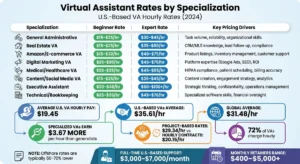
Virtual assistant service pricing ranges from $5 to $50 per hour. Agencies charge monthly retainers of $500 to $2,000. Freelancers bill hourly or per task.
AI tools cost a flat subscription. The right choice depends on your task volume.
The model you pick shapes how you manage workflow and budget. Each works best under specific conditions. Knowing which fits your operation saves money.
This is the standard for project-based work. You pay only for minutes used. It suits one-off tasks like setting up a CRM or auditing emails.
Track time strictly or the bill doubles. Many agencies require a minimum hourly commitment each month. This prevents inconsistent usage.
A retainer is a fixed monthly fee for a set number of hours. You bank unused hours or pay for overages. It offers budget predictability.
It suits clients with steady, recurring workloads. You don't invoice weekly. The VA treats your business as a priority.
The trade-off is low utilization. You pay even if hours go unused.
Some VAs charge a flat fee for specific deliverables. Think "organize my inbox" for $100. This is rare for ongoing support.
It works for clear, defined scopes. If the scope creeps, the price spikes. Use it for simple, repeatable items.
For complex admin work, hourly or retainer models usually deliver better value. Always compare the flat rate against an hourly equivalent.
The labor rate is only the base price. Real expenses stack quickly when you factor in tools and oversight. Many business owners forget these hidden layers.
They assume a cheap VA means a cheap operation. That assumption usually backfires.
You need a shared platform for communication. Slack, Asana, or Trello are standard. Each costs money per seat.
If your VA needs access to your main software, you might need an extra license. Some agencies include these in their retainer. Freelancers often expect you to provide the accounts.
Check virtual assistant time tracking tools for accurate billing. This ensures you pay only for work actually done.
Your new VA needs SOPs. They need to learn your systems. This takes time.
If you hire a freelancer, that time is billable. You are paying them to learn your business. Agencies often absorb this cost.
They pre-train their talent pools. This saves you hours of hand-holding. But it drives up their hourly rate.
You pay for the expertise upfront.
You cannot delegate and disappear. You must review work, approve tasks, and handle escalations. This management effort has a real cost.
If you are a founder, your time is worth $200/hour. Two hours of VA management is $400 in hidden cost. Factor this into your total budget.
You are choosing between three distinct paths. Each offers different levels of risk and control. The right fit depends on your volume and risk tolerance.
| Feature | Freelancers | Agencies | AI Automation |
|---|---|---|---|
| Cost Structure | Hourly ($10-$50/hr) | Retainer ($500-$2k/mo) | Subscription ($20-$500/mo) |
| Best For | Project spikes, niche skills | Ongoing admin, volume | Repetitive, rule-based tasks |
| Risk Level | High (no backup) | Low (team backup) | Medium (hallucinations) |
| Setup Time | High (SOPs needed) | Low (pre-trained) | High (configuration) |
Freelancers are direct hires. You deal with one person. If they get sick, work stops.
You get flexibility but carry high risk. They work well for specialized creative or technical tasks. You save on overhead but lose on continuity.
Agencies act as a talent pool. You get a team, not one person. If one VA leaves, another steps in.
This continuity is valuable. You pay a premium for that safety net. The service is consistent.
You don't have to screen for quality. The agency handles it.
AI Automation uses software like Zapier or AI agents. It handles repetitive tasks instantly. It does not get tired or take time off.
However, it lacks judgment. It cannot handle complex client disputes. Use it for data entry or initial email sorting.
Keep humans for complex decisions.

Your stage of business dictates what you can afford. A startup might not need a full-time exec. A funded company might not need to save a dollar.
Match the tier to your cash flow.
You likely have low task volume. A retainer would waste money. Start with an hourly freelancer.
Use a free virtual assistant resources tools guide to manage basics. Keep costs under $500/month. Focus on one or two core tasks.
Avoid complex contracts.
You have steady operational needs. A retainer makes sense here. You need reliability.
Look at virtual assistant pros and cons to weigh your options. You might hire a dedicated VA. Consider a virtual executive assistant for high-level support.
Budget $1,500 to $2,500 monthly. That covers management overhead.
Your volume is high. You need speed. Agencies are your best bet.
They scale with you. You can add hours instantly. Use tasks to outsource to a virtual assistant lists to fill their hours.
For real estate support, check what is a real estate virtual assistant for niche options. Budget $2,000 or more.
Small errors compound quickly. These five mistakes hurt your bottom line. Avoiding them saves hundreds per month.
Unlimited Scope Creep: You define "admin support." Your VA starts doing social media and bookkeeping. The rate was for admin. You are now paying admin rates for senior tasks. Define roles clearly. Use a virtual assistant tasks list to lock scope.
Ignoring Time Zone Gaps: You pay for 40 hours. They work at night. You only review in the morning. Tasks sit for 24 hours. You pay for idle time. Align schedules or use async workflows.
No Trial Period: You commit to a year. The fit is wrong. You are stuck. Always start with a two-week pilot. Test the workflow, quality, and communication before locking in. Verify the what can a virtual assistant do limits first.
Forgetting Software Costs: You use five tools. The VA needs access. You buy extra seats. These add up fast. Audit your stack. See what is virtual assistant skills needed for the tools you run.
Churn Without Handover: Your VA leaves. No documentation. No handover. You restart onboarding. You lose momentum. Require SOP documentation as part of the contract. If they leave, the business doesn't break. For medical practices, understand what does a virtual medical assistant do before making handover calls.
For independent worker classification, refer to the IRS guidelines to avoid tax liabilities.
Your task volume is the strongest predictor of which model fits. Use this quick guide before you sign anything.
Match the model to your workload today, not to what you hope your business will be in six months. Revisit the choice quarterly.
Rates range from $5 to $50 per hour depending on location and experience. Offshore VAs charge $5 to $20. US-based VAs charge $25 to $50.
Senior specialized assistants command more. Always ask about minimum hours and software fees upfront.
A retainer is a fixed monthly fee for a set number of hours. You typically pay in advance. Unused hours may roll over.
Agencies usually offer retainers starting around $500 to $2,000 per month. This model suits steady, ongoing workloads.
Yes, in most cases. Offshore rates are 50 to 70% lower than US rates. The trade-off is time zone alignment and language fluency.
Many US businesses use offshore VAs for administrative tasks and keep onshore talent for client-facing work.
The big ones are software licenses, onboarding time, and your management hours. Factor in 2 to 4 hours of your time per month for oversight. Also budget for extra seats on tools like Slack, Asana, or your CRM.
These add up quickly.
Always start with a paid trial period of at least two weeks. Define the scope of work in writing. Include an exit clause that lets you leave without penalty.
Require SOP documentation from day one. Never sign a long-term commitment based on a sales demo alone.




















how to create SOPs for virtual assistants is harder than it sounds. You’ve got one VA handling email, another doing bookkeeping, and a third managing social…
The problem most founders face isn’t hiring the wrong person, it’s giving them work that lives nowhere concrete. If you’ve ever wondered how to manage virtual…

How to communicate with a virtual assistant effectively comes down to one simple truth: these systems aren’t mind readers. They’re patternmatching machines…